Why Putin Is Unlikely To Show His Face at St. Petersburg Extravaganza
Your guide to what's news in foreign affairs — and why it matters.
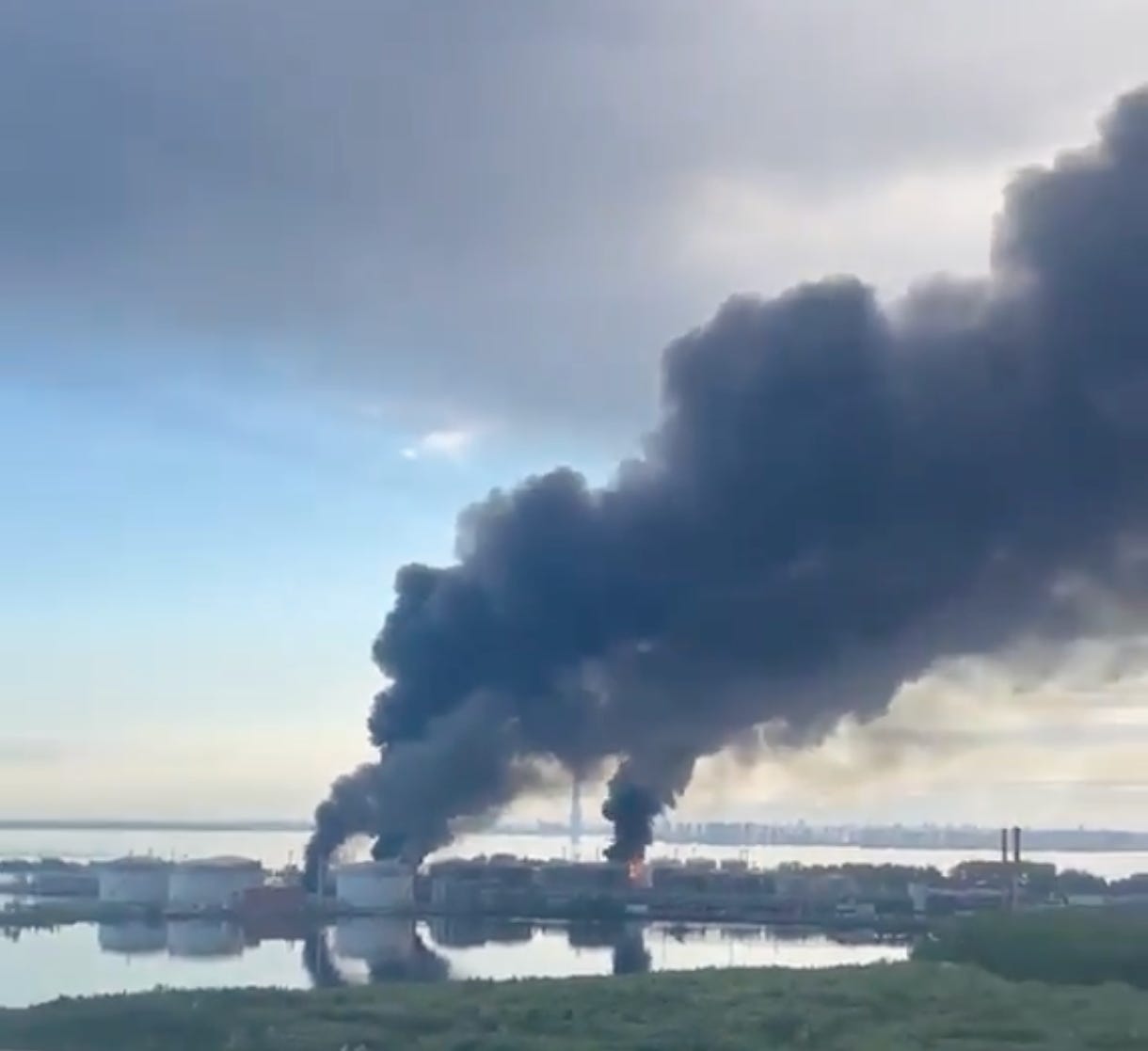
UKRAINE STRIKES ST. PETERSBURG OIL TERMINAL
It looks like Russian President Vladimir Putin forgot to put in his request for a ceasefire with President Trump in time for this year’s Saint Petersburg International Economic Forum.
The gathering is Russia’s version of Davos. Ukraine was not invited, but its military showed up.
It put on quite a show Wednesday striking port facilities and oil-storage units at the St. Petersburg oil terminal using its long-range drones, capable of traveling more than 600 miles.
Ukraine also struck a Russian naval vessel — the Boykiv, a Project 20380 corvette — in a dry dock at the Kronstadt Naval Base near the city. The ship is part of the Russian Navy’s Baltic Fleet. It is designed for multi-role operations, including surface and airborne targets, supporting coastal strikes and has been used to escort Moscow’s shadow oil fleet.
Russian presidential aide Yury Ushakov told state-owned TASS that Mr. Putin is scheduled to deliver a “grand speech” in St. Petersburg Friday. But given Russia’s inability to secure its skies, he will likely have to call in.
In the balance: Ukrainian President Volodymyr Zelensky said the operation involved the Unmanned Systems Forces, Security Service of Ukraine, Special Operations Forces, the State Border Guard Service, and other units. The joint operation has yet again put on display Ukraine’s ability to strike deep into the Russian interior.
Kyiv is denying Russia sanctuary. “There are good results from our long-range sanctions. Important facilities on Russian territory were hit overnight,” Mr. Zelensky commented. “Ukraine’s plan for long-range strikes is being carried out exactly as needed to bring peace closer.”
The strike comes several days after intense Russian aerial bombardments of Ukrainian cities, including the capital city, Kyiv, and Dnipro.
IRAN’S SUPREME LEADER IS STILL ALIVE?
Secretary of State Marco Rubio testified Tuesday before the Senate Foreign Relations Committee that there are “indications” Iranian Supreme Leader Mojtaba Khamenei “is increasingly engaging at some level” in negotiations.
Mr. Trump added to the confusion when he told “Pod Force One” host Miranda Devine Wednesday that he expects to meet the leader “depending how it all works out.” He echoed Mr. Rubio’s comments from the previous day, telling Ms. Devine, “He’s involved, absolutely. Yeah, I think they have a lot of respect for him.”
“I haven’t had the privilege of meeting him,” Mr. Trump added. “If you believe the stories, he’s missing a lot of different parts.” He continued: “They say he is giving approval, because that’s the way it has been for a long, long time. His father and then him, I guess it’s a succession. But we seem to be getting along quite well.”
In the balance: To date, there has been no proof of life for Mojtaba Khamenei. There have been statements attributed to him and read on his behalf — including just today — but he has not been seen or heard in public. If true, this would be a significant intelligence disclosure.
Reports of Khamenei’s status have been far and wide. They range from being killed February 28 in the initial strike on his father’s residence in Tehran to being severely wounded and evacuated to Moscow to tend to his injuries.
The Wall Street Journal reported May 7 that Iranian President Masoud Pezeshkian held a 2½-hour meeting with the supreme leader.
According to Pezeshkian, “What stood out to me more than anything else in this meeting was the manner of interaction, the perspective, and the deeply humble and sincere way in which the Supreme Leader conducted himself; an approach that turned the meeting into an environment based on trust, calmness, empathy, and direct conversation.”
While it is possible the ayatollah is still alive, it remains to be seen. The more likely scenario is that he is dead or incapacitated, and the Islamic Revolutionary Guard Corps is using his likeness to maintain legitimacy.


