
While Hormuz Stalls, U.S. Energy Forges Ahead
Power American hands and American materials generate can't be weaponized.
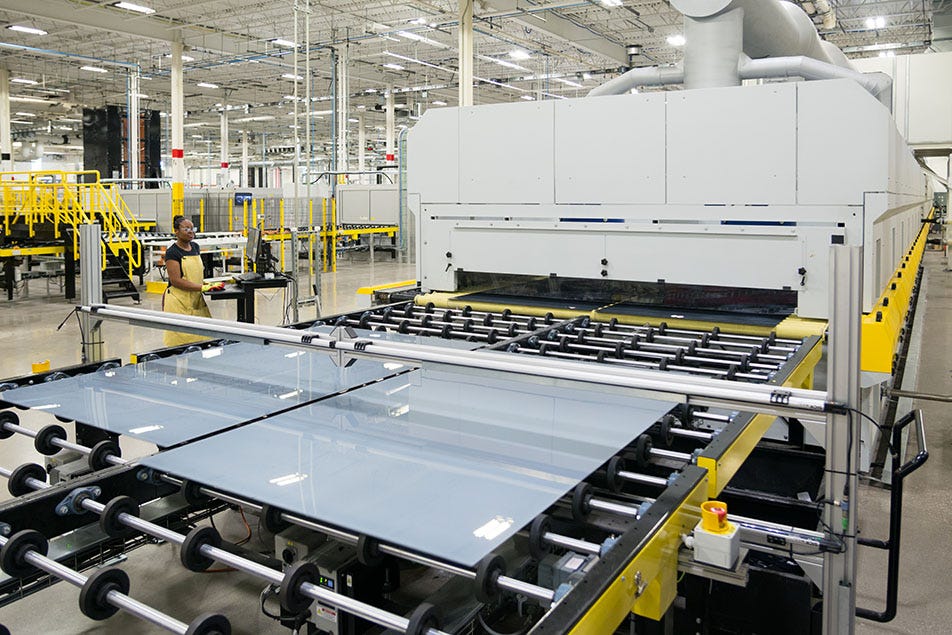
President Trump made the reindustrialization of America the centerpiece of his economic agenda — and it’s working. Factories are coming back on American soil. The trade policies critics called “reckless” are producing exactly what they were designed to produce: American jobs, American capacity, and American independence from hostile foreign powers.
Nowhere is that success more concrete than in solar manufacturing — one part of America’s all-of-the-above energy strategy and arguably the area where reindustrialization is having the biggest boom right now. The conflict that closed the Strait of Hormuz February 28 is proving the point right now, in real time, with real consequences.
Shipping traffic has fallen to roughly 5 percent of prewar levels. Brent crude surged more than 55 percent in the conflict’s first month. European gas benchmarks nearly doubled. The Philippines declared a national energy emergency. Japan scrambled for alternatives. India rationed liquefied petroleum gas. China — which Iran allows through as a favored partner — moved to hoard what it could while the rest of the world scrambled. The International Energy Agency called it the largest supply disruption in the history of the global oil market.
American oil production has stepped into the breach. A record number of supertankers are routing west to load U.S. crude for global markets — a direct validation of President Trump’s energy-dominance agenda. The United States is not a victim of this crisis. We are the solution to it. And the next frontier of that dominance —the energy that cannot be disrupted at all, no matter what happens in the Persian Gulf — is power generated right here at home from American-made solar panels.
Consider the contrast. A solar panel manufactured by an American company in Ohio, Alabama, or Louisiana — with Pennsylvania glass and Mississippi steel — does not need the Strait of Hormuz. It cannot be cut off by an Islamic Revolutionary Guard Corps mine, blocked by an Iranian naval patrol, or held hostage by a regime demanding a “toll” for passage. American workers built it, with American technology and American materials, in an American factory. The electricity it produces costs the same today as it did February 27. That’s what real energy independence looks like.
This didn’t happen by accident. It happened because President Trump’s trade policies forced the issue. His tariffs on Chinese solar dumping — imposed in his first term and significantly expanded in his second — succeeded in their aim: They made it economically viable to build solar panels in America instead of importing them from a Communist adversary.
The Washington establishment and K Street trade groups, whose policy positions often align more closely with China’s interests than America’s, said tariffs would raise costs and kill the industry. They were wrong. American companies invested billions in domestic factories and spawned thousands of jobs because the president created the conditions for competition, and the One Big Beautiful Bill Act expanded on that foundation.
The result is real and measurable. The United States can now produce gigawatts of solar-panel capacity annually using American-owned technology. Factories in places like Perrysburg, Ohio, Iberia Parish, Louisiana, and Lawrence County, Alabama, are capable of generating the capacity equivalent of building 14 nuclear reactors per year without any dependence on Chinese crystalline silicon.
The stakes are only getting higher. America is in a race to build the artificial-intelligence infrastructure that will determine who leads the next century of technological competition, and that race runs on electricity. Texas alone had a backlog of 233 gigawatts of data-center and large industrial loads at 2025’s end — the equivalent of 20 New York Cities’ worth of power. The grid can’t keep up. Gas, coal, and nuclear carry the backbone of the load, but they can’t do it unaided. Solar is one of the fastest and most scalable ways to add new generation capacity, and it’s one of the clearest reindustrialization success stories we have.
But here’s the critical question for anyone who cares about American sovereignty: Will these solar panels be made in Ohio or Wuhan?
Let me be clear: Solar is not a replacement for gas, coal, or nuclear. It is one essential part of America’s energy portfolio — and it happens to be the piece where domestic manufacturing is advancing fastest. The question for American policymakers isn’t whether solar gets built. It’s whether the panels are manufactured by American workers in American factories with no ties to China or shipped from China or one of its Belt and Road outposts in Southeast Asia.
Global solar manufacturing has become dangerously concentrated in Chinese supply chains, built on Chinese polysilicon and subject to growing legal scrutiny in the United States. Allowing companies tied to the Chinese Communist Party to set up shop on American soil and capture American taxpayer subsidies is not free trade — it’s a con.
The president understands this. This is why the One Big Beautiful Bill Act makes sure American incentives go to genuinely American companies, not to Chinese front operations laundering their supply chains through Texas.
Energy dominance and reindustrialization are not competing priorities — they are the same. Producing oil and gas at home frees America from the Strait of Hormuz. Producing solar panels at home frees America from the strategic leverage of the Chinese Communist Party. Both put American workers first.
America is building the energy infrastructure that will power the next century of economic and technological competition. That infrastructure will run on gas, nuclear, solar, and storage. The president’s trade policies have already begun bringing that manufacturing home.
The Strait of Hormuz is effectively closed. The fuel crisis is happening right now. The supertankers routing to American ports are a validation of American energy production — but they also confirm that global oil markets are integrated, and no amount of domestic drilling fully insulates American consumers from a global price shock (though it clearly does reduce impact). The energy that cannot be weaponized is the energy made here with American hands and American materials, generating electricity that never has to cross a mine-laden strait. The only question left is whether we finish the job. The answer, for anyone who puts America first, is obvious: We build it here — now, urgently, at scale — before the next crisis begins.
Chris Johnson is the founder and president of the American Energy Leadership Institute.


