

Trump Says Tech Companies Will Pay Energy Costs Under Ratepayer Pledge
Hundreds of stakeholders have signed it.
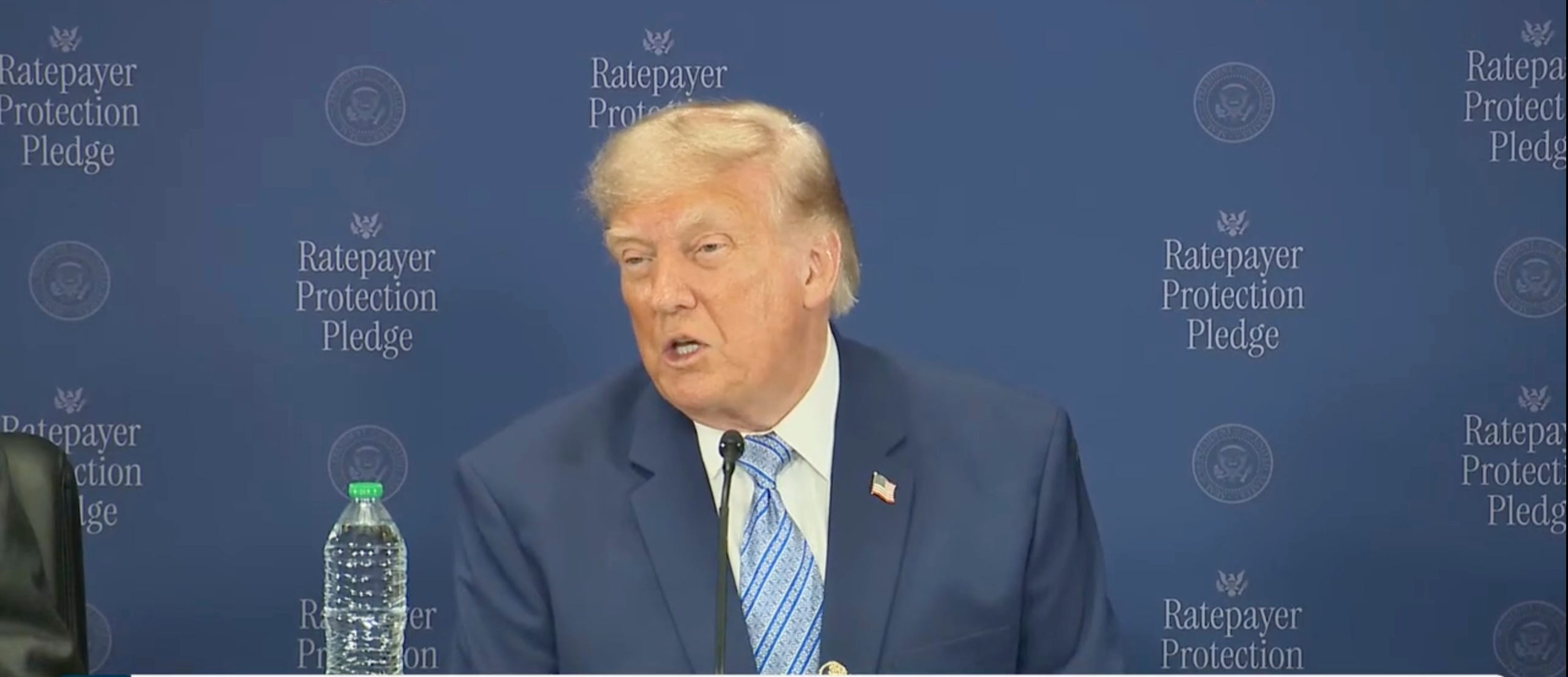
President Trump said Thursday large technology companies will pay for the power infrastructure their artificial-intelligence data centers require, arguing the policy will protect household electricity customers while advancing American dominance in AI.
Speaking about his Ratepayer Protection Pledge at the Environmental Protection Agency, Mr. Trump said rapidly expanding data centers will require more than twice the electricity the country now produces, and relying on the existing grid will not meet that demand.
“With the Trump administration’s ratepayer-protection plan, the American innovators and consumers thrive to win together because we’re insisting that AI data centers and big tech companies pay their own way, and that’s what they’re doing,” he stated.
The pledge is voluntary and nonbinding, and the administration has not identified penalties for companies that fail to follow it.
Firms signing on can build power plants for their facilities, the president said. Any surplus power could enter the grid, increasing the electricity supply and helping reduce rates.
Mr. Trump’s announcement comes nine days after Democratic New York Governor Kathy Hochul issued an executive order pausing new data-center approvals in the Empire State for one year. “As data-center development threatens to hike up utility bills, deplete our natural resources, and create uncertainty for New Yorkers, it’s my responsibility to take action and lead,” she said.
Mr. Trump is far more bullish on data-center growth. He described AI as potentially more consequential than the internet and said the United States is leading China in its development. He framed the infrastructure initiative as necessary to preserve that advantage.
“Whoever wins that race is probably going to win. Period,” he said.
The president introduced the pledge in March, and under it, he said, major technology companies have committed to finance or construct all energy infrastructure needed to meet the demand they place on the grid.
More than 220 utilities, technology companies, state governments, and other partners have signed the pledge, Mr. Trump said, although the Associated Press puts the number at “nearly 200” entities. He asserted pledge participants deliver about 80 percent of the electricity supplied to American homes and businesses, and the plan is helping keep those rates in check.
Governors who signed the pledge are Kay Ivey of Alabama, Mike Dunleavy of Alaska, Sarah Huckabee Sanders of Arkansas, Brian Kemp of Georgia, Brad Little of Idaho, Mike Braun of Indiana, Kim Reynolds of Iowa, Jeff Landry of Louisiana, Tate Reeves of Mississippi, Mike Kehoe of Missouri, Greg Gianforte of Montana, Jim Pillen of Nebraska, Joe Lombardo of Nevada, Kelly Armstrong of North Dakota, Mike DeWine of Ohio, Kevin Stitt of Oklahoma, Henry McMaster of South Carolina, Larry Rhoden of South Dakota, Bill Lee of Tennessee, Greg Abbott of Texas, Spencer Cox of Utah, Patrick Morrisey of West Virginia, and Mark Gordon of Wyoming — all Republicans.
Three of the nation’s 26 Republican governors have not signed the pledge: Ron DeSantis of Florida, who signed a state law this year imposing data-center regulations, Kelly Ayotte of New Hampshire, and Phil Scott of Vermont. No Democratic governors have signed on.
The president cited several projects as examples of consumer utility rates being protected. He said Southern Company’s Georgia Power has frozen household base rates through 2029. The utility says the freeze extends through at least the end of 2028, meaning no base-rate increase is expected before 2029. Mr. Trump also said anticipated revenue from data-center development could allow Columbia County, Georgia, to eliminate homestead property taxes.
Mr. Trump said Alliant Energy’s data-center agreements in Iowa have enabled the utility to freeze consumer electricity rates for at least five years. American Electric Power projects up to $16 billion in consumer-cost offsets from its data-center contracts, he said.
The president also highlighted Meta’s Louisiana data-center project, whose planned investment has grown from $27 billion to more than $50 billion. He said eligible Richland Parish public-school teachers are receiving annual supplemental payments, based on a local sales tax, of as much as $50,000 this year. Entergy projects Meta’s contributions will save its Louisiana customers approximately $2.65 billion over 20 years.
“With the ratepayer-protection pledge, we’re creating a fair deal for everybody,” Mr. Trump said. “This is how we’ll grow our economy, lower the cost of living, protect American consumers, and lead the world in AI and high tech, all at the same time.”
Participants included EPA chief Lee Zeldin, Energy Secretary Chris Wright, governors Mr. Kemp, Mr. Landry, Mr. Little, and Mr. Pillen. Also there were Entergy CEO Drew Marsh, Southern Company CEO Chris Womack, Meta President Dina Powell McCormick, Columbia County Commissioner Doug Duncan, and Richland Parish School District Superintendent Sheldon Jones.
Mr. Trump said companies have also agreed to invest in communities hosting data centers, including job training and local services. He argued the facilities bring substantial employment and revenue with little disruption.
The president criticized opponents of new energy development, saying their policies would raise electricity prices, limit oil, natural-gas, and coal production, and weaken the country’s position against China.
Mr. Trump framed the pledge as part of a broader effort to maintain American leadership in artificial intelligence over the country.
“As president, I’ve always said that America’s goal must be to dominate the future, and that includes being the number-one superpower in artificial intelligence,” he said.
He also criticized Democrats and “the radical left,” saying their energy policies would raise, rather than lower, electricity prices.
Mr. Trump concluded by urging communities to accept the projects, saying locations that decline them risk losing the investment to competitors.
“If you don’t take all that money, somebody else is going to take it,” he said. “You might as well do it yourself.”
 | A guest post by
|