Trump Receives Religious-Liberty Report Calling for Clarity on Establishment Clause
The commission also advises investigating terrorist-linked antisemitic attacks.
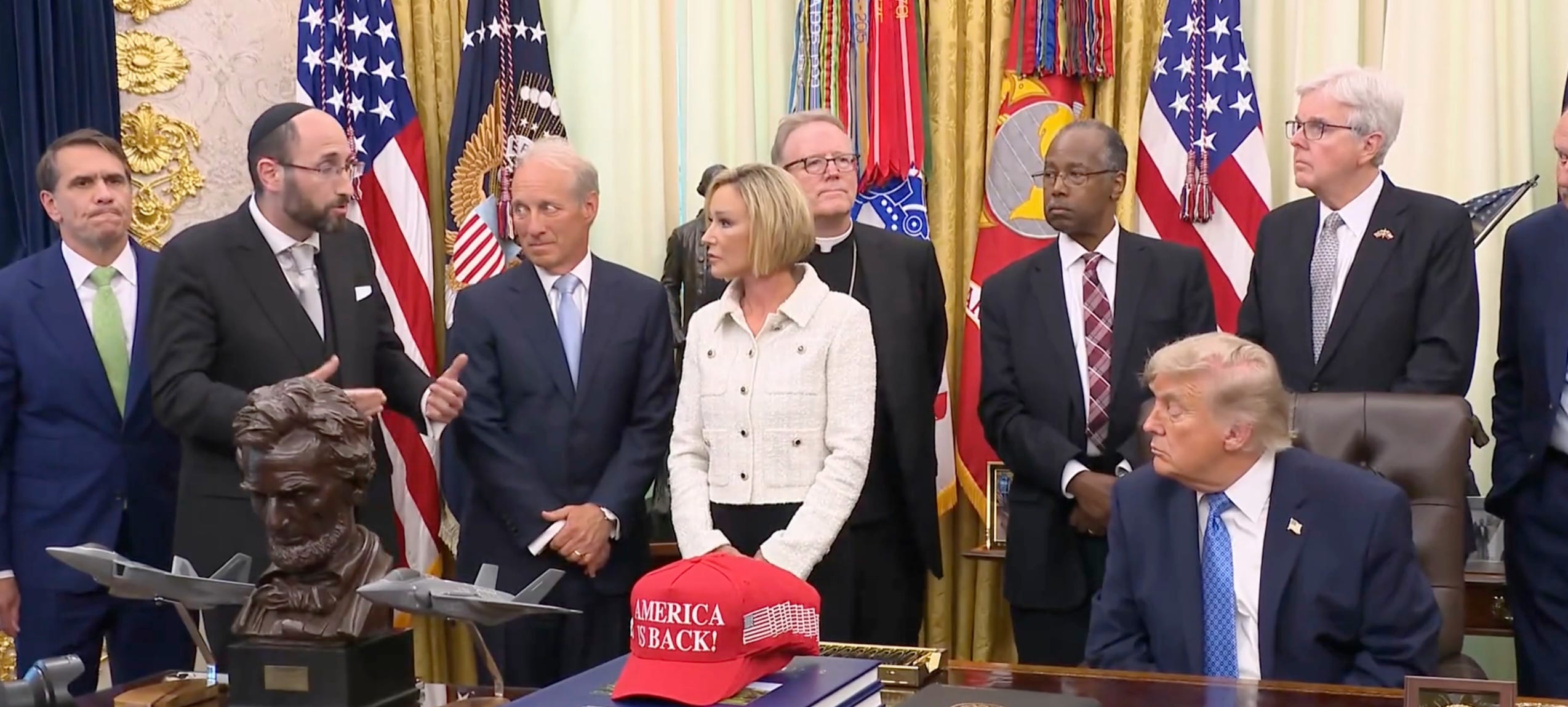
President Trump received a sweeping draft report Friday from his Religious Liberty Commission recommending a dozen federal actions, including issuing clarity on the establishment clause and investigating possible terrorist-backed antisemitic attacks.
“We are delivering recommendations to improve religious freedom for all Americans nationwide, and we have a President of action,” commission member Kelly Shackelford, First Liberty Institute president and CEO, said after the Oval Office meeting. “This is a great gift to every American, and it’s especially appropriate on the 250th birthday of our country.”
The 224-page report urges the administration to reshape federal policy on religious liberty, challenge what commissioners describe as misconceptions about the constitutional separation of church and state, expand protections for religious expression, and repeal the Johnson Amendment, which prohibits tax-exempt nonprofits such as religious groups from weighing in on political candidates.
It also recommends religious-liberty reporting portals, a Justice Department task force, improved military religious accommodations, restoration of benefits for servicemembers affected by COVID-19 vaccine mandates, and creation of a Presidential Medal of Religious Liberty.
The report devotes an entire chapter to rising antisemitism, citing testimony from Jewish leaders and students who described harassment, intimidation, and exclusion. It calls for expediting civil-rights investigations, litigating credible allegations of antisemitic discrimination and violence, expanding civic education, and improving incident tracking. It also advises Justice Department investigations into whether terrorist organizations are financing antisemitic attacks.
“I’ll be heading back now for Shabbat to New York. As you know, Jewish community there faces a lot of threats, and it’s a scary time in New York right now,” Rabbi Meir Soloveichik, leader of Manhattan’s Congregation Shearith Israel, told the president. “I, for one, am profoundly grateful for your leadership on this matter and the incredible leadership of the Justice Department on this matter and of the entire administration.”
The president promised to publicize the panel’s proposals.
“We have some incredible recommendations, but a recommendation doesn’t mean anything. This group can sell, and that’s what we’re going to be doing. We’re going to bring religion back even stronger,” Mr. Trump said. “Religion has made a tremendous resurgence in our country.”
The president established the commission by executive order in May 2025 to examine threats to religious liberty and recommend federal responses. Friday’s report was released in draft form and will remain open for a 15-day public-comment period.
Texas Lieutenant Governor Dan Patrick, the commission chairman, said members heard testimony from 103 witnesses over seven months, with teachers, students, parents, military chaplains, servicemembers, private-sector employees, health-care workers, and religious leaders describing harassment, intimidation, or discrimination because of their religious beliefs.
“The overwhelming majority of our witnesses said that they were attacked and punished, and what was used against them was one phrase that’s not in the Constitution,” he said, referring to “separation of church and state.”
The report recommends Justice Department guidance on the establishment clause. The panel spent much time pondering the First Amendment and the definition of religious freedom and free exercise, said Bishop Robert Barron, who leads the Catholic Diocese of Winona-Rochester in Minnesota.
“No one in this commission wants an established religion, but we all want the free exercise of religion, and we sense that being limited in different ways. I think we also sense that behind a lot of the particular offenses, there was this great battle, you might say, with what I call the culture of self-invention,” he said. “I invent who I am, I determine what’s good, and the avatars of that culture realize that the religious people stand athwart that view.”
Ben Carson, the commission’s vice chairman and housing secretary during Mr. Trump’s first administration, also pointed to America’s architects.
“Our founding document says that our rights come from our creator and not from government. And people who try to divorce us from that heritage, do they realize that that’s our founding document? Do they realize that our Pledge of Allegiance says we are one nation under God? Do they realize that in many courtrooms in the land, on the wall, it says, ‘In God We Trust’? That every coin in their pocket, every bill in their wallet, says, ‘In God We Trust’?” Dr. Carson said. “So it’s in all those places, but we’re not supposed to talk about it. Maybe we need to see a psychiatrist.”


