

Trump Defender Todd Blanche Confirmed as Attorney General
The Senate recesses without a vote on the SAVE America Act.
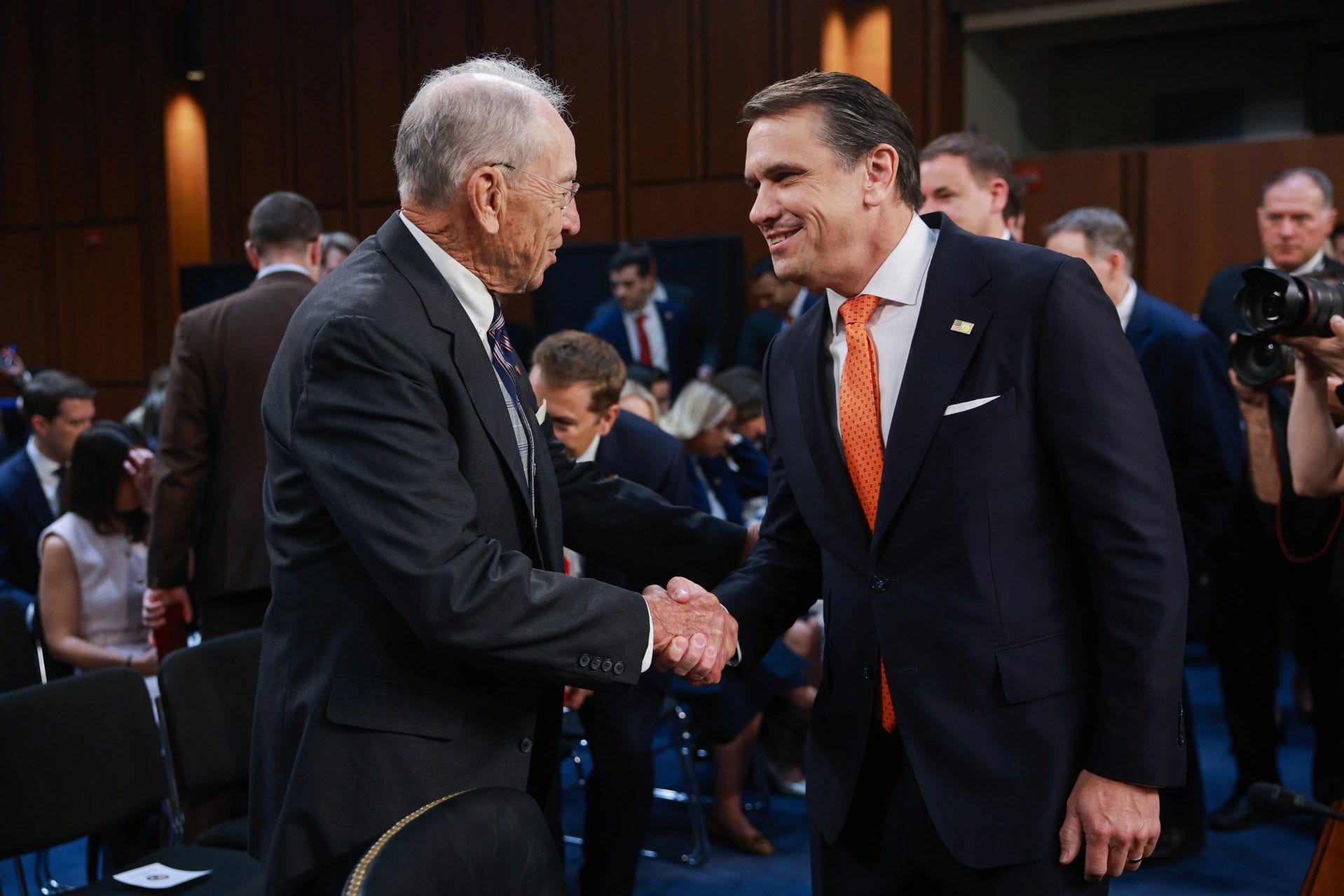
The Senate confirmed Todd Blanche, a former defense attorney for President Trump, as attorney general early Saturday in one of several moves as the upper chamber sprinted towards a weeks-long recess.
Mr. Blanche has held the top Justice Department position in an acting capacity since Mr. Trump fired his predecessor Pam Bondi April 2.
The 50-49 vote came at 4:30 a.m. during a marathon pre-recess session that also saw passage of a continuing resolution that will keep the federal government open through November’s midterm elections.
Kentucky Republican Senator Mitch McConnell, released from rehabilitation last week, remained absent and did not vote. GOP Senators Susan Collins of Maine and Lisa Murkowski of Alaska voted with all Senate Democrats against Mr. Blanche’s nomination.
House passage of the CR would remove the issue of a government shutdown from the midterm-election campaign, something both Democrats and Republicans favored with the 90-6 vote. The House is expected to take up the resolution in September after returning from its own August recess.
Senators did not vote on a proposal to require voter ID at the polls, one element of the SAVE America Act,” however, disappointing Senator Mike Lee and other advocates.
“We got Todd Blanche confirmed as the attorney general, that’s a good thing,” the Utah Republican said in a video posted to social media. “We got the government funded through December 11th, and that’s a good thing along the lines of the White House’s priority.”
But, he said, “tragically, the SAVE America vote on the voter-ID component failed. Not a single Democrat joined us. We’re going to have to keep fighting on that one. We’re not done. We’re just getting started.”
Mr. Lee also said he was “outvoted” on a measure to keep the Senate in session.
“That was the first time, as far as I’m aware, in decades when any vote has been held on a significant recess or adjournment, and I hope to have more of those in the future,” he said.
Mr. Blanche’s fate was in doubt until shortly before 11 a.m. Friday, when Louisiana Republican Senator Bill Cassidy, a physician, announced he would support the nomination, clearing the way for confirmation.
Republicans hold a 53-47 Senate majority, but Mr. McConnell said he won’t return until September, meaning Mr. Blanche could afford to lose only two Republican votes if all Democrats opposed him. With Ms. Collins and Ms. Murkowski defecting, Dr. Cassidy’s vote became decisive.
“All considered, I will vote for Mr. Blanche,” he said on the Senate floor. “I’ll be criticized for this vote. What’s new? But the people of Louisiana can be assured that I worked hard to understand the issue and to make the right decision.”
Ms. Murkowski announced her opposition in a post on X early Friday morning, hours before Dr. Cassidy disclosed his decision.
“I have had numerous constructive meetings with Mr. Blanche and he comes across as decent and capable,” Ms. Murkowski wrote. “Ultimately, however, I will oppose his nomination.”
Ms. Murkowski said the Justice Department’s politicization had accelerated and cited concerns about the handling of the Epstein files, immunity protections involving Mr. Trump and his family, and investigations targeting political figures.
Both Ms. Murkowski and Ms. Collins — the latter embroiled in a hot reelection battle in Maine this year — also criticized Mr. Blanche over his stance on abortion. The two senators are staunchly pro-choice.
Dr. Cassidy’s vote also carries significance because of his strained relationship with Mr. Trump. He was one of seven Republican senators who voted to convict the president at his second impeachment trial in 2021. He later clashed with the administration over health policy, including concerns about Robert F. Kennedy Jr. before ultimately voting to confirm him as health secretary.
The president endorsed Congresswoman Julia Letlow in this year’s Louisiana Republican Senate primary. Dr. Cassidy finished third in the May 16 primary, failing to advance to the runoff and ending his chances for reelection.
Confirmation of Mr. Blanche predictably drew fire from New York Democrat Chuck Schumer, the Senate minority leader, who blasted the vote as “an excuse on a silver platter” for what he said was the president’s “pervasive, breathtaking corruption.”
Mr. Schumer declared, “Todd Blanche has no intention of stopping Trump’s corruption. He advanced his career enabling it. Every senator who voted to confirm him has now branded themselves as an enabler, too.”
One of those alleged “enablers,” newly installed Senator Darline Graham, South Carolina Republican, took to social media in praise of Mr. Blanche’s confirmation. “I was proud to vote to confirm Todd Blanche as Attorney General of the United States,” Ms. Graham wrote, adding Mr. Trump “couldn’t have chosen a better nominee. Mr. Blanche is highly qualified. I know he will work hard to fight fraud and protect the safety of South Carolinians.”
Another contentious matter involved the implementation of a federal ban on hemp-derived THC products. The items — gummies, vapes, beverages, tinctures, and “gas-station weed” — are widely sold with little age verification at convenience stores, gas stations, smoke/vape shops, liquor stores, and online, exploiting the 2018 Farm Bill’s 0.3% delta-9 THC loophole.
National Poison Data System figures show nearly 10,000 delta-8 THC exposure cases since 2021, with roughly 40 percent involving pediatric patients and children under 6 accounting for a large share of critical-care admissions. Those figures prompted Republican Senator Ted Budd of North Carolina to push against a proposed one-month delay in implementing the ban.
The Budd amendment would have struck a provision from the CR delaying the ban’s effectiveness date from November 12 to December 11, keeping the original deadline intact despite White House opposition. The Senate tabled it 61-32 Saturday morning, letting the delay stand.
Supporters of the extension say it will give Congress time to draft clarifying legislation. Mr. Budd said the products have created a health crisis.
The CR also contains language blocking implementation of an Office of Management and Budget rule requiring a senior political appointee to review grants before awarding. Democrats said the policy would cut funds to Democrat-led states; advocates said it would improve accountability. The delay lasts through December 11, when the CR expires.
 | A guest post by
|