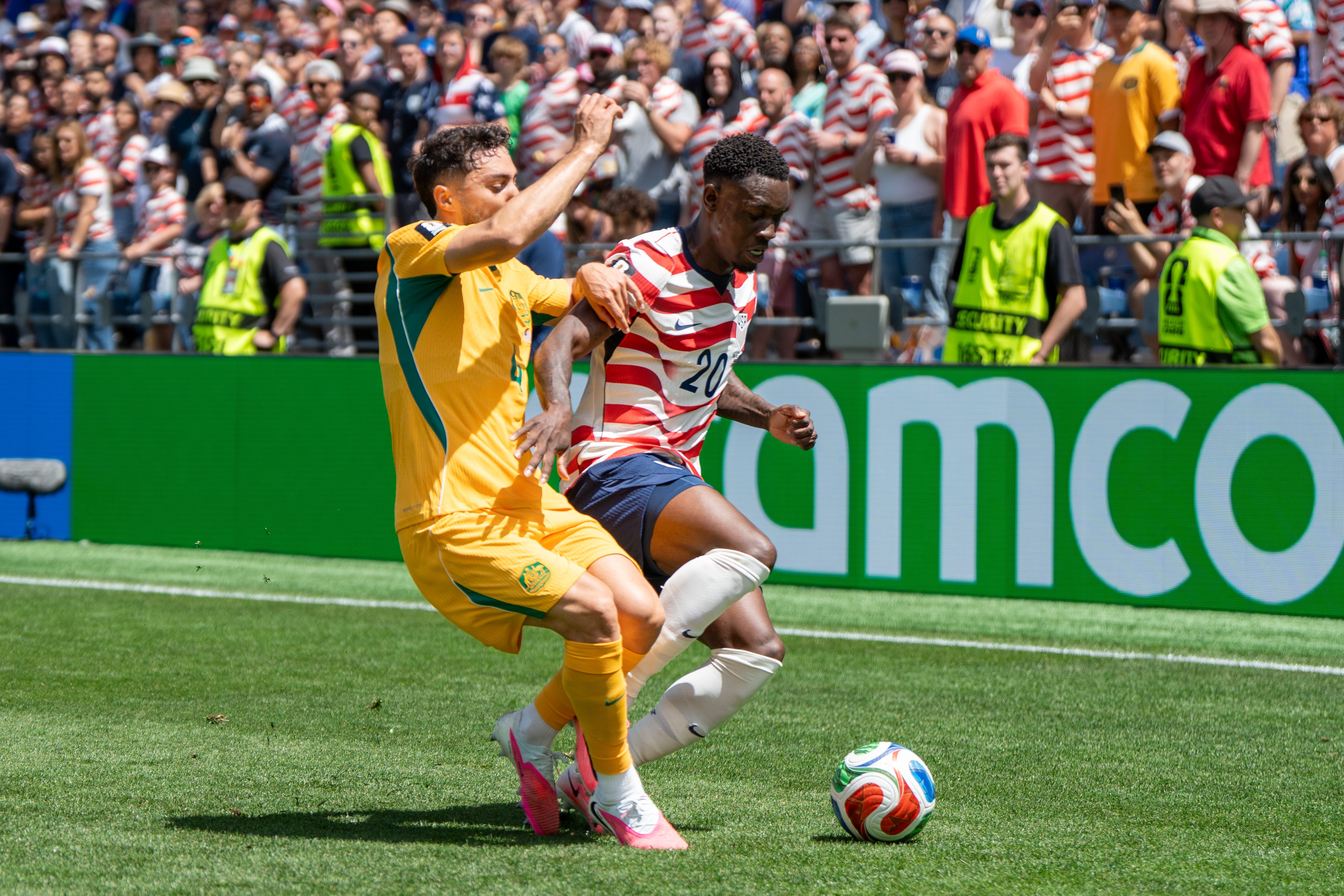
Trump Confirms He Called FIFA Boss but Denies Demanding Red-Card Suspension
Star striker Folarin Balogun will play in tonight's game against Belgium.

President Trump confirmed Monday he called the head of international soccer’s governing body requesting a review of star striker Folarin Balogun’s controversial red card — but denied he demanded the suspension FIFA gave it.
FIFA’s Sunday decision, which holds the next-game disqualification for a one-year probationary period, allows America’s top scorer to play Monday night’s Round of 16 in Seattle versus Belgium.
A referee gave Mr. Balogun, who was born in Brooklyn but raised in London, the red card July 1 after reviewing footage of his foot landing on Bosnia and Herzegovina’s Tarik Muharemović during play. America won the game without Mr. Balogun for the rest of the match, and fans of many countries considered the call unfair.
“I’m a person that loves sports and was a good athlete, and I understand sports really well, really well. And that wasn’t a foul, that wasn’t even an infraction. That was two guys running full speed that happened to crash into each other,” Mr. Trump told reporters in the Oval Office.
Mr. Balogun, the president said, “didn’t do anything wrong, and he’s our best player or one of our best players, a very vital player. And he gave him a red card. I didn’t know what that meant. I didn’t think it meant much.”
Once he learned the call would keep Mr. Balogun off the pitch against Belgium, Mr. Trump went into action and phoned FIFA boss Gianni Infantino.
“It’s one thing to penalize somebody for the game, but how do you penalize them for a game that hasn’t been played yet? It’s very unfair. You can’t do this,” he said. “So, yes, I asked for a review by FIFA.”
“All I did was ask for a review. I didn’t say, ‘You have to do this.’ I spoke to a man who’s highly respected and, by the way, whose level of respect has gone up tenfold, and he was good before this started, but you know he really pushed it in this country,” the president said.
“I can’t tell him what to do, and I don’t believe he made the decision,” he added. “I think it was a committee that made the decision, and they made the right decision.”
Mr. Infantino acknowledged the telephone appeal. “During our conversation, I explained that there was an ongoing legal process involving FIFA’s independent judicial bodies and that the case would be decided in due course by the competent bodies,” he said.
Mr. Infantino and Mr. Trump have known each other for more than 10 years; the soccer boss awarded the president FIFA’s inaugural Peace Prize in December.
The Union of European Football Associations said FIFA “crossed a red line” by putting a hold on the penalty. Belgium’s team filed an appeal against the move, but FIFA discarded the move saying Belgium “has no standing” to do so.
A suspension, permitted under Article 27 of FIFA’s rules, was also granted last year to Portuguese soccer legend Cristiano Ronaldo, who got a three-game ban in November’s World Cup qualifying match for elbowing Irish player Dara O’Shea. FIFA ruled Mr. Ronaldo could play in the tournament this year, and he has.
Despite his professed unawareness of what a red-card penalty means, Mr. Trump has had more than a passing interest in soccer, known elsewhere in the world as football.
Years ago, the yet-to-become president considered investing in Glasgow’s Rangers Football Club, The Guardian reported. He was also rumored in 2015 to be part of a $100 million bid for Atlético Nacional, a Colombian team once linked to drug lord Pablo Escobar.
Mr. Trump did own the U.S. Football League New Jersey Generals, which folded when the fledgling league did in 1986.
The FIFA move on Mr. Balogun’s suspension drew howls of protest from soccer fans, including “Canada Hates Trump,” an account boasting 232,000 X followers. “Trump has singlehandedly turned millions of us into Belgium fans,” it wrote.
But GOP communications consultant Ellen Carmichael said the intervention by Mr. Trump reflects how Americans act when wronged versus a more flaccid European response.
“Europeans waxing poetic about the sanctity of the game are, of course, talking about a governing body whose last tournament host was decided via confirmed cash bribes — one that imposed dress codes on women, shrugged off widespread allegations of modern slavery and reconfigured the entire tournament calendar to suit the host country,” she wrote, referring to the World Cup held in Qatar. “Which is exactly the point. If you’ve made peace with all of that, at least enough to watch the tournament four years later, a probationary suspension isn’t actually a scandal.”