

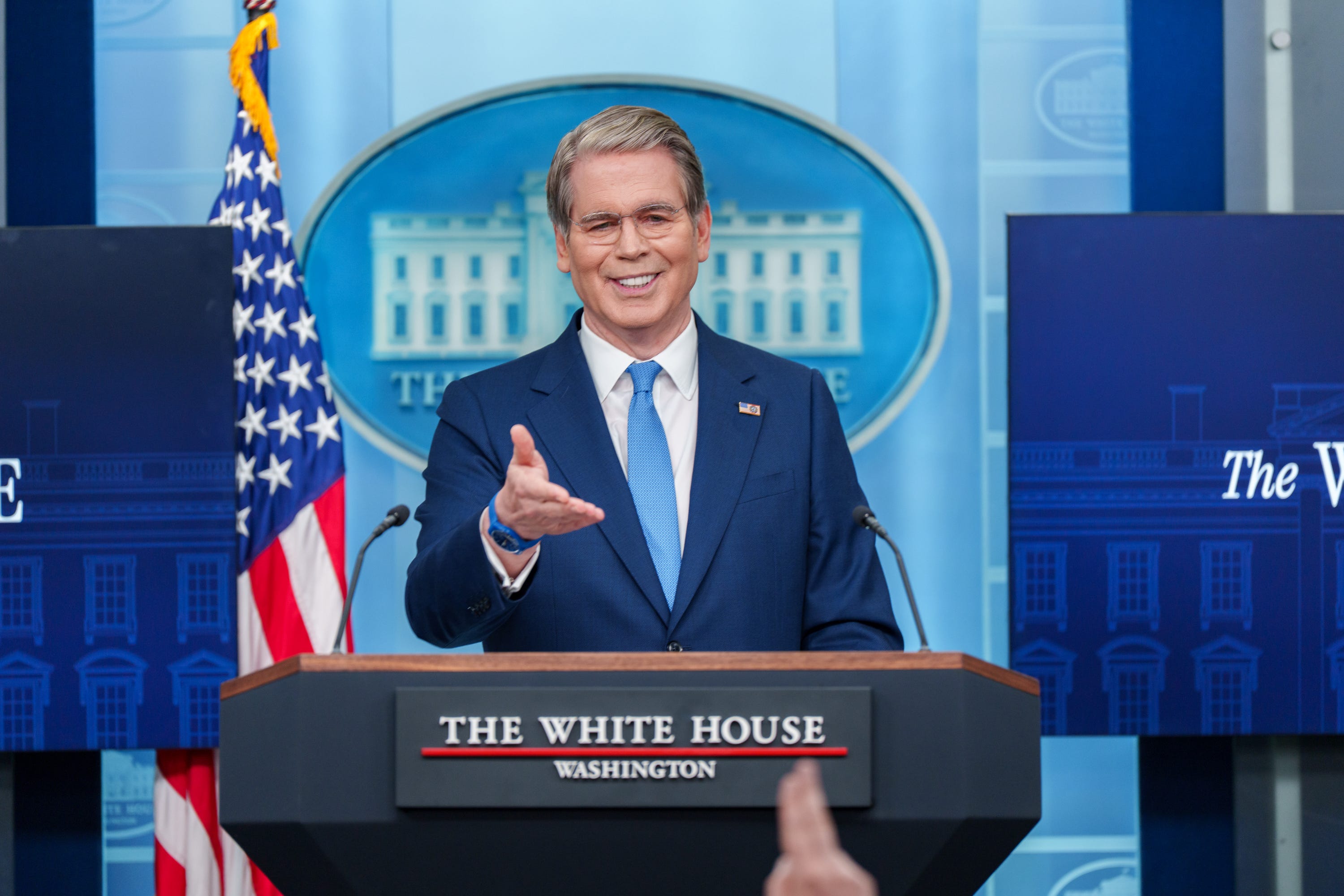
The Trump administration is preparing what Treasury Secretary Scott Bessent called Thursday the “toughest sanctions in history” against Iran and warning countries that continue supporting Tehran will face severe economic penalties.
President Trump announced the coming campaign Wednesday, promising “Economic Warfare and Isolation on an unprecedented scale” against Iran.
“ANY country that allows its financial institutions, businesses, airports, or government entities to provide any type of lifeline to Iran will itself face TREMENDOUS Economic Consequences. Oil smuggling, swap lines, cash transfers, exchange houses, ship registries, front companies — It all needs to stop NOW. You know who you are. This will be an ECONOMIC D-DAY, and we need all of our Allies to stand with the United States of America to isolate, and defeat, the Iran threat. These maniacs are on the ropes, and these HISTORIC MEASURES will cripple them and their ability to project terror worldwide.” he wrote on Truth Social.
The announcement came on the anniversary of the August 19, 1953, U.S.- and British-backed clerical coup that ousted Iranian Prime Minister Mohammad Mosaddegh, a fact Iran’s foreign ministry noted in a statement denouncing Mr. Trump’s remarks: “This action is not only another indication of the continuation of 73 years of hostility and animosity by U.S. policymakers toward the Iranian people but also further demonstrates the anti-human, lawless, and hegemonic nature of the U.S. ruling establishment.”
Mr. Bessent said Thursday the administration will provide more details at a Monday press conference. He described the effort as working in tandem with the U.S. naval blockade imposed on Iran in April and paused for a month beginning in mid-June.
“It is a one-two punch. We have the blockade, and we are going to have the toughest sanctions in history,” Mr. Bessent told CNBC. “This is going to be the greatest coordinated economic isolation in the history of the world. And we are going to them and saying you are either with us or against us,” he said of the message to American allies.
Mr. Bessent also said the economic campaign could reduce the likelihood of another major military escalation: “If we are doing the maximum economic pressure, then that means that likely there will not be a large-scale kinetic restart.”
Vice President JD Vance said the nearly six-month conflict has changed. “We’re kind of now in a new phase where the most effective tool that we have is the economic pressure that we can apply to them,” he told “The Clay Travis & Buck Sexton Show.” “Do they want to have their economy strangled for the rest of time or do they want to have a better relationship with the West?”
“This is a delicate dance because we apply economic pressure to them, they’re going to try to apply economic pressure to us, but what has been true over the last couple of weeks is they felt a lot more pressure than we have,” Mr. Vance said.
China presents one of the biggest tests for the administration’s strategy. More than 80 percent of Iran’s shipped oil goes to China, based on 2025 data from analytics firm Kpler.
Asked whether Washington could target China for continuing business with Iran, Mr. Bessent said some discussions were better conducted privately. He nevertheless urged Beijing “to get with the program.”
China bought an average of 1.38 million barrels of Iranian oil per day in 2025, per Kpler. Chinese refiners have developed trading and payment systems designed to limit exposure to U.S. sanctions.
Other countries also maintain substantial economic relationships with Tehran.
Turkey’s bilateral trade with Iran runs about $5 billion to $6 billion annually, while Iraq’s trade with Iran exceeded $10 billion in 2025, according to official Iraqi trade figures. Iraqi energy officials said Iraq also pays Iran about $4 billion to $5 billion annually for natural gas.
The United Arab Emirates, historically one of Iran’s largest trading partners, this week suspended all financial and economic transactions with Iran until further notice.
Mr. Trump did not specify what countries or businesses maintaining ties with Iran will face. Mr. Bessent’s promised Monday announcement could clarify what penalties Washington intends to impose and how broadly it intends to apply them.
