

The U.S-China 21st-Century Space Race Heats Up
The People's Republic made a great leap forward Friday.
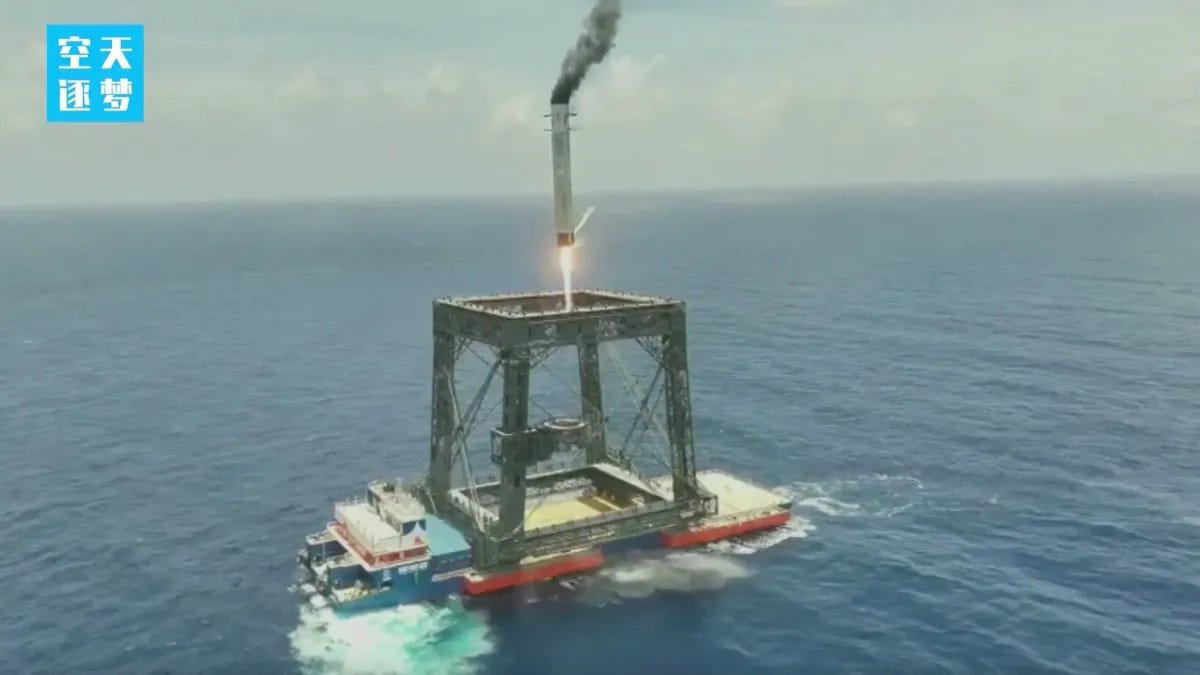
The China Aerospace and Technology Corporation today successfully launched its Long March 10B space rocket and recovered its reusable launch vehicle. Uniquely, the recovery happened on a landing platform affixed atop a ship at sea.
Citing Chinese state-owned CASC, Space.com noted the “Long March 10B is a two-stage rocket that stands about 207 feet (63 meters) tall.”
The space rocket’s initial stage uses “kerosene and liquid oxygen (LOX) propellants, whereas the second stage uses LOX and liquid methane.” The rocket is designed to carry “16 tons of payload [into] low Earth orbit.”
Heretofore Elon Musk’s SpaceX has dominated this market segment. Its Falcon 9 rocket “revolutionized the industry” by returning its reusable first stage to “the launchpad upright after launch,” as The New York Times reported.
To date, SpaceX has been able to launch more than 10,000 communication low-orbit satellites into space as part of its Starlink network. Thus far in 2026, SpaceX has launched upwards of 95 satellites into space compared with only 46 by China. Its reusable first stage is largely why this gap increased.
China’s emerging ability to launch large numbers of satellites with reusable rockets will enable it to close the intelligence, surveillance, and reconnaissance gap — and closing that gap will have significant U.S. national-security consequences.
In the balance: Notably, the Department of Defense, in its 2025 Annual Report to Congress: Military and Security Developments Involving the People’s Republic of China, assessed that China had 359 ISR-capable satellites in orbit.
United States Space Force reported in April there are now more than “510+ Chinese ISR-capable satellites.” If accurate, that represents a significant leap forward for the People’s Liberation Army.
ISR-capable satellites are essentially a military’s eyes and ears in space.
They gather on a 24/7 basis imagery, radar, and signals intelligence to track adversaries and facilitate command and control of military operations.
The United States, by comparison, has 300 ISR single or dual use military satellites in orbit, per Todd Harrison. xwThe actual number is classified.
But quantity is not the same as quality. The capabilities of U.S. ISR satellites still significantly outpace the Chinese. Yet as China works to improve its ISR satellites, once they come online, its reusable Long March 10B rockets could help Beijing quickly close the gap.
The National Reconnaissance Office and Space Force ISR satellites are just one category of the United States’ space capabilities. There are also communication, GPS navigation, missile warning, and a new evolving category tasked with space-domain awareness. That last refers to tracking space debris, avoiding collisions, and creating target data sets.
Safeguarding these satellites going forward is a major priority for the Pentagon. Communication satellites are critical for nuclear command and control as well as tactical forces.
Navigation satellites are vital for GPS. Missile warning — as evidenced during the U.S.-Iran war — is vital for the detection and tracking of ballistic missiles.
Combined, the arsenal of American military and civilian satellites provide a huge advantage to the Pentagon’s ability to protect U.S. national interests and project power around the globe.
Decision point: Critically, as Space Force noted in its April report, “The People’s Liberation Army expects space to play an important role in future conflicts by enabling long-range precision strikes and denying other militaries the use of space-based information.”
Meanwhile, China is also rapidly “growing its arsenal of standoff weaponry to enable long-range precision strikes against U.S. and allied forces.”
In the not-too-distant future, Beijing’s growing space capabilities could prove decisive in any conflict between the United States and China in Taiwan if left unchecked.
America must redouble its efforts to maintain its advantage in space. Although he was roundly criticized for it at the time on Capitol Hill, President Trump was right to stand up Space Force.
There is still a lot to accomplish. Maintaining America’s edge will require increased funding for resilient satellite architectures and accelerated development of counterspace capabilities. It will also require far stronger partnership between the military and private U.S. space companies.
The risk is imminent. As we warned two years ago, Russian President Vladimir Putin has been exploring how to use nuclear weapons to cripple the America’s eyes and ears in space. And as Space Force noted, as early as 2007, China successfully used one satellite to destroy another.
Star Wars suddenly is getting very, very real.
 | A guest post by
|
 | A guest post by
|