
Supreme Court Hands Trump Administration Two Immigration Wins
Thursday's four rulings include asylum, gun-rights, and Monsanto cases.
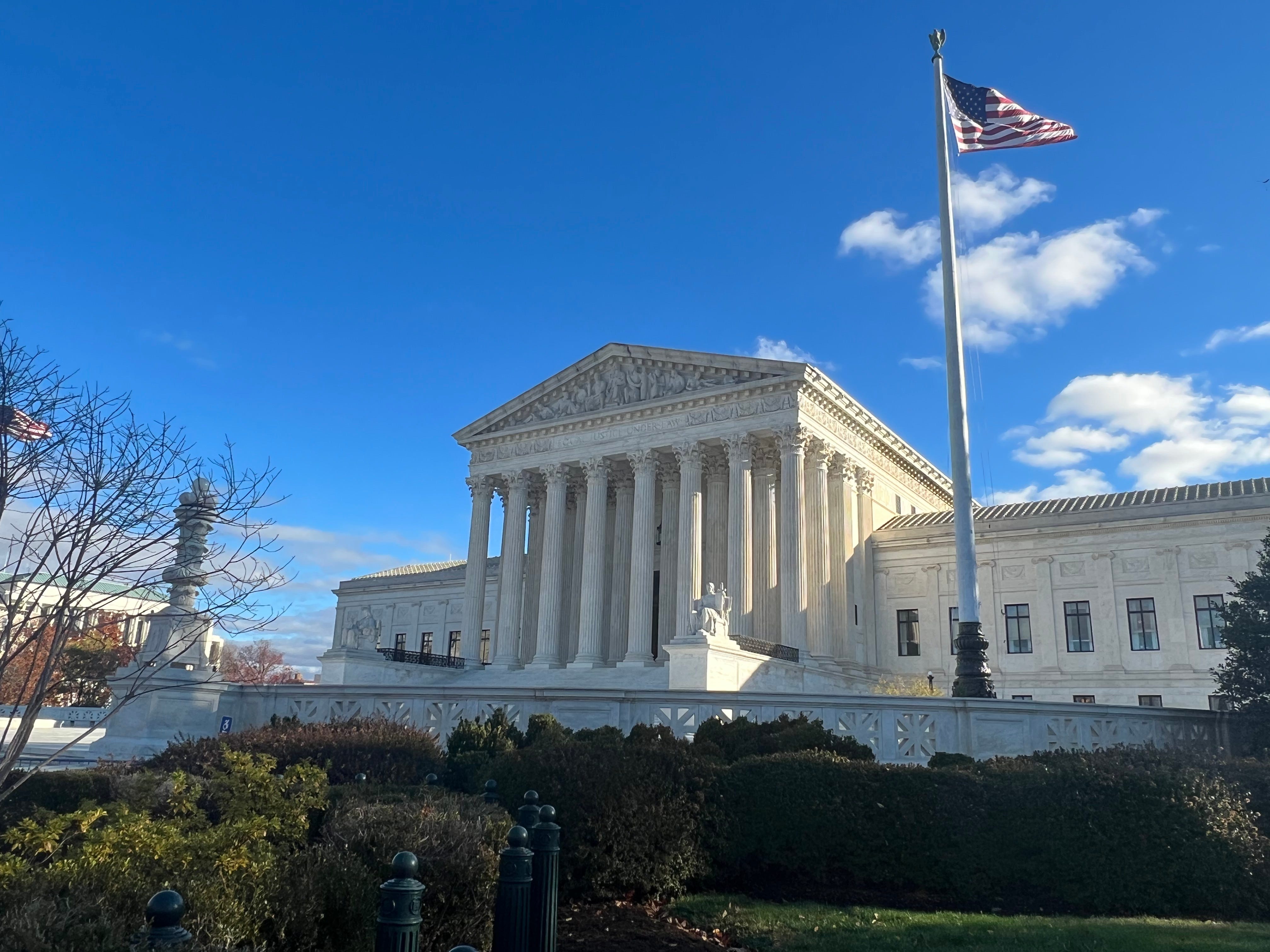
The Trump administration notched two immigration wins Thursday as the Supreme Court handed down four divided rulings on immigration enforcement, asylum, gun rights on private property, and pesticide liability, with the justices splitting over executive power, the protections owed noncitizens, and the limits of federal preemption over state injury suits. The court has eight decisions left before the term ends next month.
In the most closely watched case, Mullin v. Doe, the court cleared the way for the administration to end Temporary Protected Status for 6,000 Syrian and 350,000 Haitian immigrants allowed to live and work in the United States because conditions at home are deemed unsafe.
“We hold that the TPS statute’s judicial-review bar applies to all non-constitutional claims,” said Justice Samuel Alito, writing for the majority. The court found a remaining equal-protection claim by Haitian TPS holders unlikely to succeed because “none of the cited statements by either the President or the Secretary was overtly racial, and in substance all expressed policy views that could rest on race-neutral justifications.”
In a concurrence, Justice Clarence Thomas argued noncitizens have no Fifth Amendment equal-protection rights against the federal government.
Justice Elena Kagan dissented, joined by Justices Sonia Sotomayor and Ketanji Brown Jackson, accusing the majority of ignoring direct evidence of racial bias. “The majority claims to see no evidence that race played any role in the Haiti decision,” she wrote. “But the evidence is there, plain to see, in the President’s statements, which the majority — and for that matter, his own lawyers — cannot even bear to repeat.”
Her dissent cited the president’s description of Haiti as a “shithole country” that is “filthy, dirty, disgusting” and his question, “Why is it we only take people from shithole countries” rather than “Norway [and] Sweden?”
The ruling drew immediate fire from Republican Congressman Mike Lawler, who posted on social media that Haiti is “a humanitarian and political disaster” and deserves a TPS extension, citing a State Department “Level 4 travel advisory” telling Americans not to go there.
The New York representative also said about one-third of the Haitians here under TPS work in the health-care system, and ending that status “will create a crisis” in that sector.
“I’m asking the administration to allow for an orderly process by which Haitian TPS holders can maintain their work authorization while their immigration cases are adjudicated over the next six months, if the revocation of TPS moves forward,” Mr. Lawler wrote. He also wants the Senate to take up a bill he’s co-sponsoring with Congresswoman Lauren Gillen, New York Democrat, to temporarily extend Haitians’ TPS status. The measure passed the House April 16 by a vote of 224-204.
The court resolved a decade-old question on federal asylum law in Mullin v. Al Otro Lado.
Mr. Alito, writing for the majority, said, “An alien who is standing in Mexico does not ‘arriv[e] in the United States’ by attempting, and failing, to set foot in this country,” reversing the Ninth Circuit Court of Appeals and upholding the government’s now-defunct “metering” practice of physically blocking asylum seekers at ports of entry. Mr. Thomas again concurred separately.
Ms. Sotomayor dissented, joined by Ms. Kagan and Ms. Jackson, writing, “The Court’s illogical interpretation is driven almost entirely by a fixation on a single word: ‘in.’”
Ms. Jackson filed a separate dissent arguing the case is moot: “Today, the Court issues an advisory opinion on the lawfulness of metering — a policy that has not been in place for almost five years and that the Government has no concrete plans to reinstate.”
In Wolford v. Lopez, the court struck down Hawaii’s law requiring property owners to expressly authorize visitors to carry firearms onto private property open to the public, a rule the state defended as an extension of its “spirit of Aloha” tradition of open access to land.
Mr. Alito, again writing for the majority, said the law violated the Second and 14th amendments. “The Second Amendment cannot give way to ‘the spirit of Aloha’ in Hawaii,” he wrote, “any more than it can yield to the spirit of the Big Apple” or “the Windy City.” Justice Amy Coney Barrett concurred separately, joined in part by Mr. Thomas and Justice Neil Gorsuch.
Ms. Kagan dissented alone, writing, “I would uphold the challenged Hawaii law because ... it is a modern-day analogue of colonial and founding era laws that similarly prohibited carrying firearms onto private property without the owner’s affirmative consent.”
Ms. Jackson, joined by Ms. Sotomayor, filed a separate dissent warning that the court’s Second Amendment test has become “a free-for-all that lets the Judiciary thwart the will of legislatures by privileging access to firearms above all else,” adding, “Hawaii’s law does not implicate the Second Amendment because there is no right to carry a gun onto private property without consent ... and the Constitution does not dictate the form of that required consent.”
The court ruled 7-2 in its fourth decision, in Monsanto v. Durnell, that federal pesticide law preempts a Missouri jury’s verdict against Monsanto over its Roundup weedkiller. John Durnell, who used Roundup for two decades and developed non-Hodgkin lymphoma, had won a state-court judgment arguing the company failed to warn of the product’s cancer risk.
Justice Brett Kavanaugh, writing for the majority and joined by Chief Justice John Roberts and Justices Thomas, Alito, Sotomayor, Kagan, and Barrett, said the Federal Insecticide, Fungicide, and Rodenticide Act (FIFRA) bars the claim because it “would impose a pesticide labeling requirement ‘in addition to or different from’ the label required by EPA,” the Environmental Protection Agency.
Federal law, Mr. Kavanaugh wrote, requires Monsanto to sell Roundup “with the label that EPA approved at the initial registration and that EPA has subsequently re-approved on multiple occasions — that is, the label without a cancer warning.” Mr. Thomas concurred separately, questioning FIFRA’s constitutionality and saying EPA “appears to ‘make substantive rules ... punishable with fines or imprisonment,’ a core legislative power that cannot be delegated.”
Ms. Jackson dissented, joined by Mr. Gorsuch, accusing the majority of rewriting the statute. “The majority reads into FIFRA a labeling requirement that does not exist, and it reads out of FIFRA the statute’s ongoing prohibition on misbranding,” she wrote, arguing Mr. Durnell’s claim “is equivalent to FIFRA’s key labeling requirement — the misbranding prohibition.”
She noted the ruling departs from “the near-unanimous view of the many state and federal courts” that have rejected Monsanto’s preemption argument, warning it “unjustifiably closes the courthouse doors to state tort plaintiffs like Durnell.”


