
Putin Puppet Lukashenko Reconsiders His Options
Belarus' president has good reason to declare he won't send troops to battle in Ukraine.
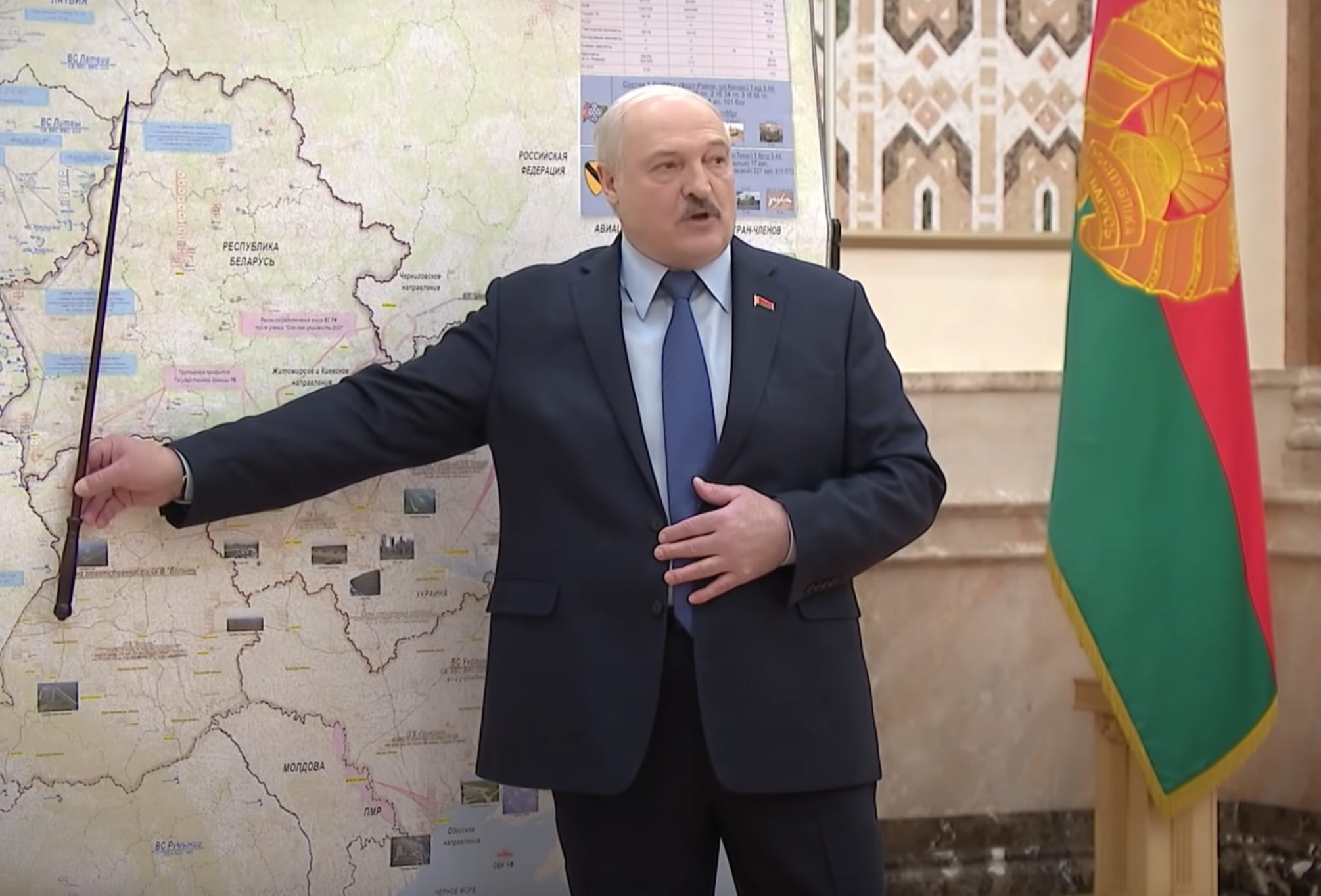
This is certainly not what the Kremlin was expecting to hear. Belarusian President Alexander Lukashenko has ruled out sending troops to fight in Ukraine, saying his soldiers would not become “cannon fodder for Russian President Vladimir Putin’s war.”
Equally surprising, his comments were not aimed just at Kyiv. During his Friday address in Grodno, he added, “I want the Poles, Lithuanians, and Ukrainians to hear me. We do not want to fight with them.”
Nonetheless, Mr. Lukashenko, who owes his continued political existence to Mr. Putin, felt compelled to state that his country’s military and defense cooperation with Russia remains unchanged. He added Minsk is prepared to defend Moscow, if necessary, but not in Ukraine or against NATO.
Mr. Lukashenko has become a tool — actually, he’s always been the Kremlin’s tool. He allowed Russia to launch its invasion of Ukraine from Belarusian territory. He let Moscow discharge ballistic missiles from inside his country’s borders. And he is allowing his military-industrial complex to continue supporting Mr. Putin’s war effort.
Just days after witnessing Ukrainian drones strike the St. Petersburg oil terminal and Kronstadt naval base before and after last week’s St. Petersburg International Economic Forum, Russia’s version of Davos, an indecisive and nervous Mr. Lukashenko is once again waffling in the face of Russia’s inability to defend itself.
If Moscow cannot defend St. Petersburg, how is Russia going to defend Minsk? The Kremlin’s track record coming to the assistance of Syria, Venezuela, Cuba, and Iran is not reassuring either. For “grandpa in his bunker” — as the popular internet meme refers to Mr. Putin — loyalty travels one way: up.
Notably, Mr. Lukashenko, likely in a fit of false bravado, offered to meet Ukrainian President Volodymyr Zelensky. He said, “I am ready to meet with him anywhere — in Ukraine, in Belarus — and discuss the problems of Belarusian-Ukrainian relations.”
Or perhaps it was fear. Especially for the “500 potential targets in Belarus” that Robert Brovdi, the commander of Ukraine’s Unmanned Systems Forces, late last month threatened to strike if Minsk becomes directly involved in the war with Kyiv.
Either way, Kyiv quickly rejected the offer. Dmytro Lytvyn, an adviser to the Ukrainian president, said, “Since 2022, it has been obvious to everyone that this man’s words mean nothing, and we should pay attention to his actions.”
What is clear is that Mr. Zelensky’s warning to Belarus in May against taking a larger role in the war is heavily influencing Mr. Lukashenko’s calculus. Mr. Zelensky said there would be “consequences,” with Ukraine prepared to take “preventive measures” in response to potential threats.
For the moment, at least, Belarus is climbing back down the escalation ladder with Ukraine. We now know why.
In the balance: Mr. Putin’s puppet in Minsk understands that Mr. Zelensky and his generals are men of action. Russian tactical nuclear weapons, mounted on Oreshnik missiles delivered and stored in Minsk, may have deterrence value for NATO.
Yet for Kyiv? Not as much.
Decision point: Still, Mr. Lukashenko is stuck between the proverbial rock and hard place. Ukraine and NATO are on one side. Domestic opposition is on the other side.
The Belarusian president cannot survive in a world without the protection of Mr. Putin. Yet paradoxically, Mr. Lukashenko is also finding out he might not be able to survive in a world with Mr. Putin at his side.
Self-exile might be Mr. Lukashenko’s only out.


