

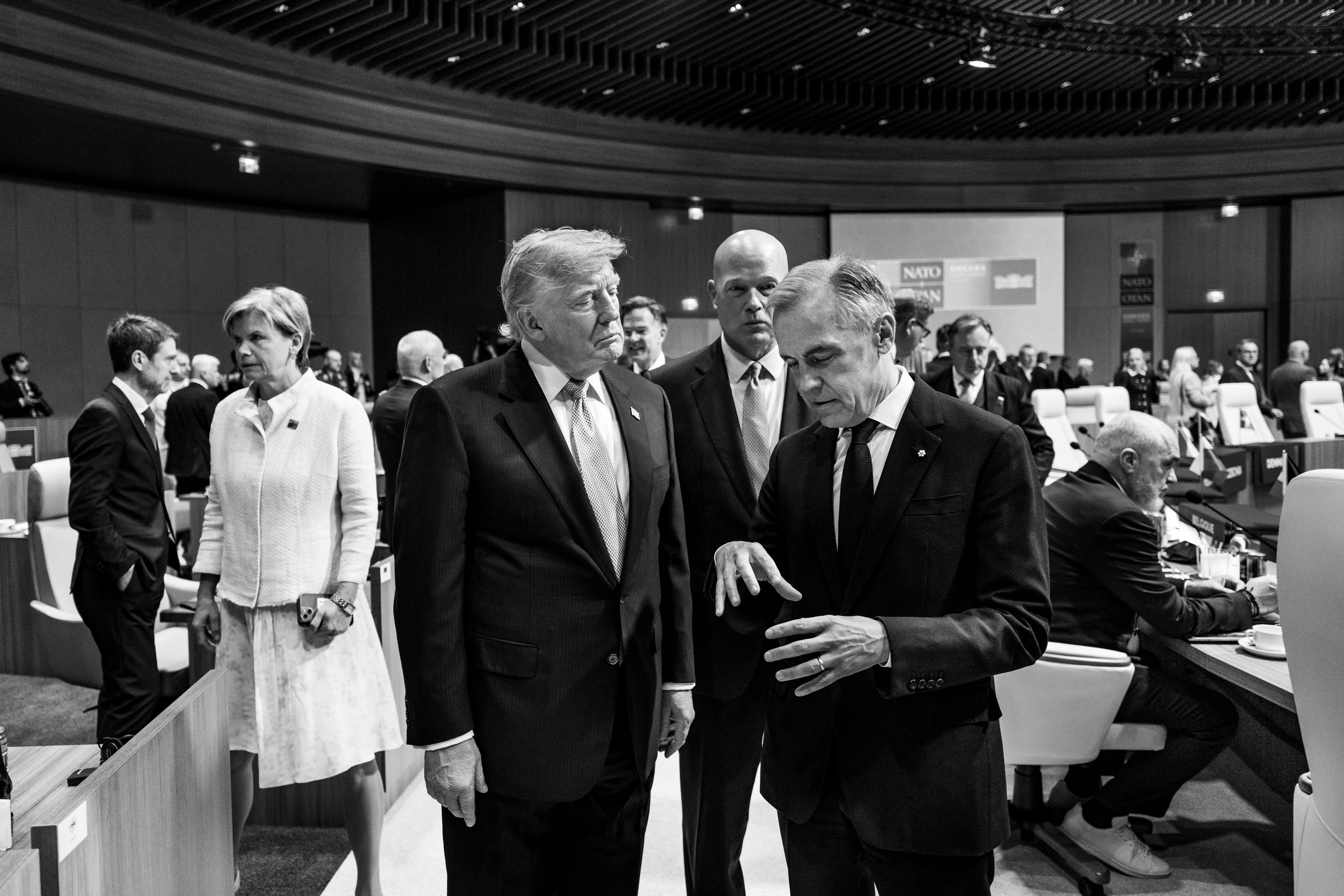
Shock 50 percent tariffs on U.S. imports of certain Canadian goods took effect early Saturday after Canada suspended bilateral trade negotiations Friday evening.
Hours earlier, en route to a rally in Myrtle Beach, South Carolina, President Trump told reporters, “The deal with Canada is moving along, and we should be able to have a deal with Canada.”
That deal may yet arrive, but the countries did not reach an agreement before the tariffs took effect at 12:01 a.m. Saturday.
Affected are imports ranging from wine, cement, and hockey sticks to certain automobiles and dairy products. The levies apply even if the covered goods qualify for preferential treatment under the United States-Mexico-Canada Agreement, a trilateral trade pact negotiated during Mr. Trump’s first term.
“Tonight, Canada declined to finalize the trade deal under the terms agreed earlier this week. Despite the U.S. offer to Canada to receive the best treatment of any major exporter to our market, new demands and walk backs of other commitments by Canada have upended the careful balance reached in the past days,” U.S. Trade Representative Jamieson Greer said. “In addition, Canada is continuing to maintain its prolonged retaliation against the United States, including, among other things, flat-out prohibitions on certain American goods and services.”
Canadian Prime Minister Mark Carney said the recent “progress has not been enough to meet our objectives for Canadians. As a result, this evening, I have decided to suspend trade negotiations with the U.S. and have directed Canada’s negotiators to return to Ottawa.”
He added, “The U.S. intends to impose a 50 percent tariff on roughly $28 billion of Canadian goods. Canada will match those tariffs dollar for dollar to protect our workers and businesses.”
Mr. Carney blamed “last-minute changes in the U.S. proposed terms,” which he called “unfair” and “uneconomic.”
Mr. Greer said, “This week, the United States agreed to provide even better treatment to Canada, offering significant tariff reductions on steel, aluminum, autos, and lumber. The U.S. offer was also forward looking, and included a historic economic and national security partnership to cooperate on export controls, combat transshipment, enhance digital trade, and align certain external tariffs.”
He called the failure “a missed opportunity for Canada to partner with the United States, which is the fastest growing economy in the G7.”
Neither Mr. Trump nor the White House had commented on the deal’s collapse as of early Saturday morning. Dominic LeBlanc, the minister responsible for Canada-U.S. trade, also did not immediately issue a statement.
Some other Canadian politicians were quick to jump on the news, however.
Ontario Premier Doug Ford said, “The prime minister has my full support for a strong response — tariff for tariff, dollar for dollar. As we fight to protect Canadian sovereignty and economic security, everything needs to be on the table. Ontario is ready to do its part.”
But Jamil Jivani, a former special adviser to Mr. Ford who represents the Bowmanville-Oshawa North district in Parliament, ripped the outcome. “Make no mistake. Since the beginning, in their public communications, Liberal politicians like Mark Carney and Doug Ford have put their political self-interests ahead of Canadian workers,” said Mr. Jivani, an Ontario Conservative. “As leaders, I believe it’s incumbent on us to be servants for the people who elected us, and the families who are relying on us to bring home the dignity that comes with a paycheck.”
