Mike Rogers Tries To Overcome History With Michigan Senate Win
Republicans believe 2026 is a rare opportunity to pick up a seat in the state.
Michigan Republicans believe 2026 is a rare opportunity to pick up a U.S. Senate seat. But with the party 0-10 in Senate contests here since 1996, history overhangs the race like a dark cloud.
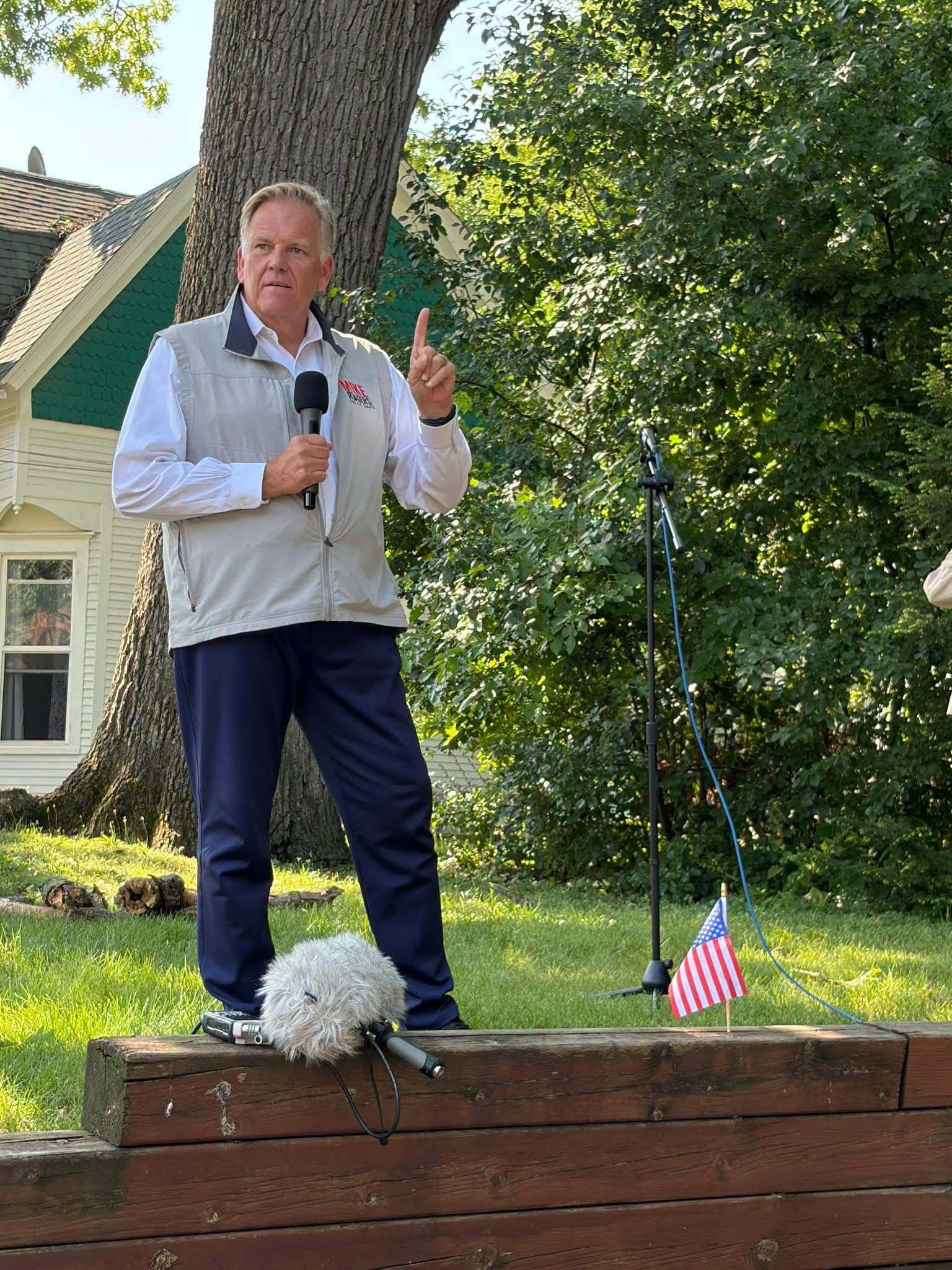
GOP nominee Mike Rogers, the former congressman who lost his 2024 Senate bid, offered optimism Monday at the Republican Party’s 172nd birthday.
“If I can get 80 percent of the vote from two years ago, I win,” Mr. Rogers told the crowd of dozens at Under the Oaks Park in Jackson, site of the first Republican convention, July 6, 1854. State elections have lower turnout in Michigan than presidential ones, giving the candidate more hope this time.
He came up 19,000 votes short against then-Congresswoman Elissa Slotkin in 2024. Ms. Slotkin play-acted as a moderate throughout the campaign, and it worked. She pulled off a Democratic win in a Republican wave year.
Mr. Rogers argues the help came late in the 2024 cycle — too late. So late that Ms. Slotkin had some success defining him as an out-of-touch, out-of-state carpetbagger, returning from Florida for the sake of power.
But now he has been campaigning for years. Any rust accrued between his 2015 exit from politics and his 2024 return has worn off.
And unlike 2024, none of the Democrats is carrying the “moderate” label well. Congresswoman Haley Stevens is favored by the Democratic establishment but not really viewed as a centrist. Abdul El-Sayed is favored by the progressive wing and endorsed by Congresswoman Alexandria Ocasio-Cortez and Senator Bernie Sanders.
Mallory McMorrow, a third contender in the Democratic primary, dropped out Sunday. Ms. Stevens and Mr. El-Sayed sparred Tuesday night in a debate hosted by Grand Rapids’ WOOD-TV.
Anna Hoffman, a conservative strategist in Michigan, notes incumbency has played a big part in Republican failures.
The last time a Republican won a Senate race in Michigan was in 1994, when Spence Abraham beat Democrat Bob Carr. The retiring Donald Riegle had held the seat since 1976, after fellow Democrat Phil Hart got sick and decided against running again; he had beat incumbent Charles Potter, a Republican, to win the seat in 1958.
Mr. Abraham’s 1994 win came with an open seat. He never defended it successfully, losing to Debbie Stabenow in 2000. Since 1959, a Democrat has held that seat every minute except Mr. Abraham’s six-year term.
Since 1994, there have been only two other open-seat Senate races in Michigan. Democrats won the 2014 race with Gary Peters and the 2024 race with Ms. Slotkin.
Ms. Hoffman said candidate quality is another issue, citing Terri Lynn Land’s struggles in the 2014 race against Mr. Peters.
During one press scrum, Ms. Land got flustered, said “I can’t do this,” and walked off. That and other missteps were features of the 2014 campaign, a race to fill the seat left open by Senator Carl Levin’s retirement. Mr. Levin won his seat in 1978, defeating Senator Robert Griffin.
Direct election of senators started with ratification of the 17th Amendment. The 1916 election was the first in Michigan where senators were elected by voters and not appointed by the legislature.
Since 1916, Republicans are 14-22 in Senate races, including the 0-10 streak. Five of the Democrats’ 22 wins came against incumbent Republican senators.
Only one Republican, Homer Ferguson in 1942, beat an incumbent Democrat (Senator Prentiss Brown).
Ms. Hoffman noted that 2026 is a unique year in Michigan. It’s the only time governor, secretary of state, attorney general, and U.S. senator — the four statewide elected positions — are all open-seat elections, with no incumbents.
“Everything comes down to turnout in November,” Ms. Hoffman told the Star.