

Michigan's 2026 Three-Way Dances Are Done
On three occasions, candidates withdrew and turned three-way races into head-to-head battles.
When 2026 began, the Michigan governor’s race was of great political interest. Lifelong Democrat Mike Duggan, a former Detroit mayor, was running as an independent.
People in Michigan and beyond asked the same questions. Could it be done? Could Mike Duggan personally do it? Could an independent take on the two-party system and win statewide?
But the experiment was never completed.
Despite entering as the only candidate without a primary field to clear — the only contender with a straightforward path to Election Day — Mr. Duggan dropped out of the race by Memorial Day, citing challenges with polling and fundraising.
November 3 went from a moment that could have made history to just another plain-Jane fight between Democrats and Republicans.
Jack Lessenberry, who’s been writing about Michigan politics for decades, told The Washington Star that candidates “drop out for a variety of reasons; normally a combination of lack of enough money plus the knowledge they are unlikely to win.”
These are the exact grounds Mr. Duggan cited when he withdrew.
“If we were even in the polls and behind in fundraising, we have a path to winning,” he said. “If we were behind in the polls and even in fundraising, we have a path. But we’re behind in both.”
In “All Politics is Local,” the late House Speaker Tip O’Neill explains that third-party candidacies like Mr. Duggan’s are doomed — because independents are easy to beat today and easy to co-opt tomorrow.
“Our two parties pit one philosophy against the other. One wins and one loses and we have stability,” O’Neill wrote in the 1994 book.
Third parties, he continued, “sometimes provide a good idea, like the Progressive Movement and the Populists, but one of the two major parties will incorporate those ideas in the next election and we continue with the two-party system.”
Only once in Michigan history had voters supported a third-party candidate. This was in the 1912 presidential election, when the state supported ex-president Theodore Roosevelt, a former Republican, over Republican President William Taft.
Roosevelt won Michigan, but Democrat Woodrow Wilson won the presidency.
Michigan had two three-way dances in 1912. Both resulted in Democratic wins. In the governor’s race, Lucius Whitney Watkins ran in Roosevelt’s party and snagged 28 percent of the vote. This allowed Democrat Woodbridge Ferris to win with 35 percent of the vote.
The Republican candidate, Amos Musselman, won 31 percent, but the split vote swept a Democrat into the Michigan governor’s office for the first time since 1890.
Then there was this year’s Democratic primary in the Senate race, which Politico called a “three-car pileup.” Two of the three Democrats — state Senator Mallory McMorrow and Congresswoman Haley Stevens — entered as elected officials. At least one of the two would be without an office by year’s end, if not both.
Abdul El-Sayed has had a more nomadic path, twice leaving high-profile public-health jobs to run for office.
Between the printing of absentee ballots and the August 4 primary, Ms. McMorrow withdrew.
“Sometimes they are told or it is hinted that if they do the right thing, drop out now, and help unite the party, something good will come their way down the line,” Mr. Lessenberry told the Star. “This very likely happened with McMorrow.”
As one Republican consultant in Michigan put it, the three-car pileup turned into a head-on collision between Ms. Stevens and Mr. El-Sayed.
Ms. Stevens is thought to benefit when Ms. McMorrow’s fanbase seeks a new home. She is also well funded, and outside groups have hit Mr. El-Sayed hard on the TV airwaves, alleging sexism on his part.
But he has grassroots popularity and momentum. Over the weekend, Mr. El-Sayed and friends like Congresswoman Alexandria Ocasio-Cortez and Senator Bernie Sanders packed the house in both Detroit and Grand Rapids, Michigan’s two largest cities.
The Republican primary in the governor’s race looked to be a three-way dance. After Reverend Ralph Rebandt failed to make the ballot, and state Senator Aric Nesbitt dropped out, there was a trio of candidates left: Congressman John James, businessman Perry Johnson, and former Michigan Attorney General Mike Cox.
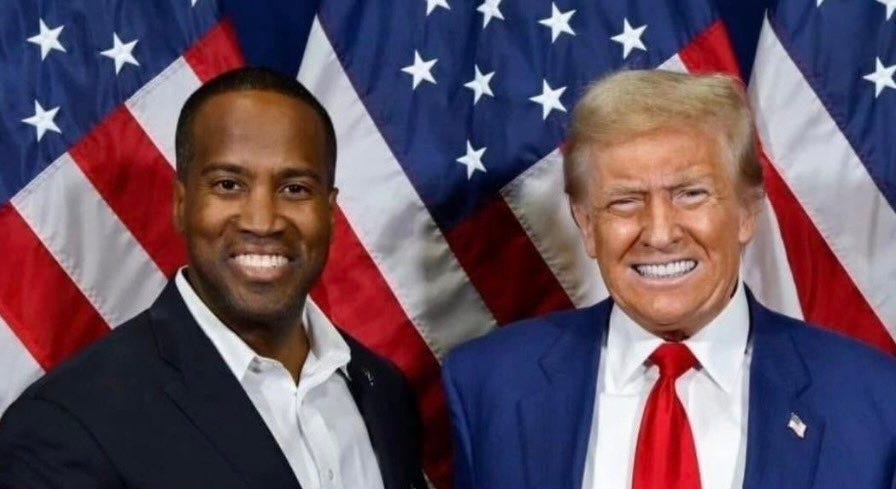
The three-man field was headed for an August 4 finish. Then President Trump endorsed Mr. James. The polling indicated that Mr. Trump’s support mattered, and voters were with Mr. James. Mr. Cox dropped out last week.
Mr. Trump’s announcement affected Mr. Cox because he was the president’s lawyer in Michigan in 2024, on the lookout for any shenanigans affecting the election. When Mr. Trump went with Mr. James over Mr. Cox, it looked like he had judged two men he knew and decided Mr. James was the better pick.
Still, Mr. Lessenberry sees the machinery of politics as possibly driving Mr. Cox’s dropout.
“Cox probably hopes Trump will appoint him to something,” he said.
 | A guest post by
|