

Michigan Senate Poll: Rogers Would Dominate El-Sayed, Neck-And-Neck With Stevens
The Democrats' battle may haunt the party in November.
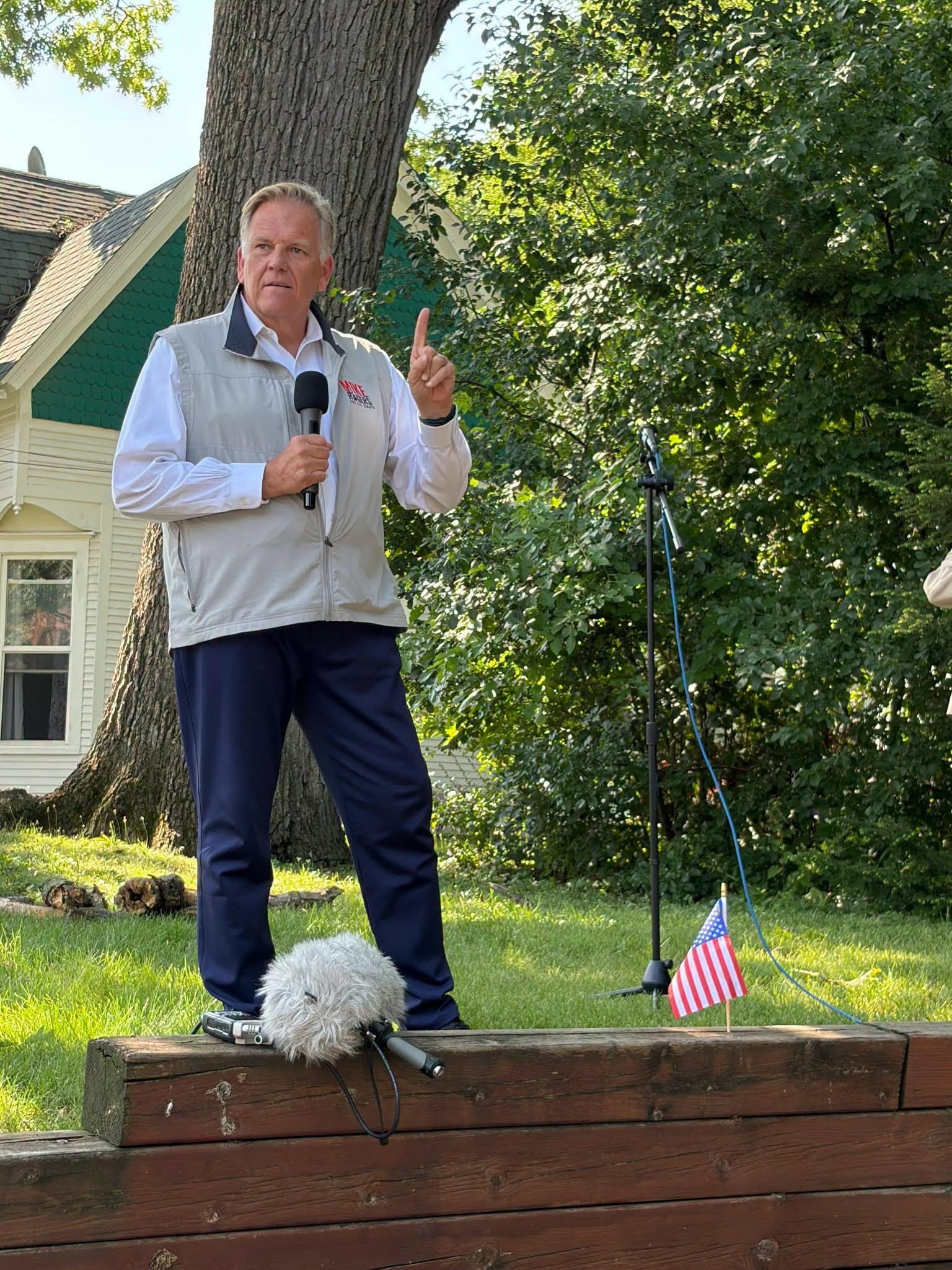
A new survey of the Michigan Senate race finds Republican Mike Rogers has a commanding lead over one Democrat — Abdul El-Sayed — but is slightly behind another: Congresswoman Haley Stevens.
The Business Leaders of Michigan and the Michigan Education Association commissioned the Glengariff poll, which was taken between July 22 and 24 and tracked 600 likely Michigan voters. The latter is the state’s largest teachers’ union.
The survey finds Mr. Rogers, a former congressman and FBI agent, has a 49-39 lead over Democratic Socialist Abdul El-Sayed.
Glengariff says “10.7% of voters remain undecided,” but that “among definite voters, Rogers holds a 7.2-point lead on El Sayed at 48.0%-40.8%.”
However, if Ms. Stevens is the Democrat nominee, the race tightens into a dead heat: 45.5 percent for Ms. Stevens to 44.7 percent for Rogers, well within the margin of error. Glengariff finds “8.9% of voters remain undecided.”
“Among definite voters, Ms. Stevens holds a 2-point lead on Rogers at 46.8%- 44.8%,” per the Glengariff analysis. “This race is a toss-up.”
READ THE FULL POLL FOR YOURSELF
Greg Manz, an adviser for the Michigan Republican Party, noted the party’s struggles in these races. Republicans are 0-11 in U.S. Senate races in Michigan since 1996. This includes three losses in open-seat races, and one incumbent (Spence Abraham) who lost his seat.
“After 32 years of one-party rule by Michigan Democrats, working families are still confronting abysmal reading scores — 45th in the nation — and an education system that has failed too many students,” Mr. Manz told The Washington Star.
“It’s time to focus on accountability, results, and common-sense policies,” Manz added, “and the only candidate doing that is Mike Rogers.”
Ms. Stevens and Mr. El-Sayed held their second debate Monday night on Fox 2 Detroit.
Throughout the hourlong contest, Ms. Stevens argued she is the more electable candidate in a general election against Mr. Rogers. At one point she cited the endorsement of Governor Gretchen Whitmer, a Democrat thought still to be popular in party circles.
The two candidates have different strategies to win the August 4 primary. The Democratic Senate primary is a battle of the party’s establishment versus its left wing.
Ms. Stevens has stacked up endorsements from establishment Democrats such as Ms. Whitmer, Senator Gary Peters, and retired Senator Debbie Stabenow.
Mr. El-Sayed brings endorsements from the likes of Senators Bernie Sanders and Liz Warren and Congresswoman Alexandria Ocasio-Cortez, who’ve visited Michigan recently to boost him.
There is not much overlap between the two coalitions. And there is a fear in Democratic circles that either fanbase would not show up for the other in November.
Ms. Stevens, for instance, is popular among black and Jewish Democrats. Would they support El-Sayed, who during public debates uses “AIPAC” — the American Israel Public Affairs Committee -- as a byword?
Among black voters, Ms. Stevens dominates. She would earn about 80 percent of votes, compared with 11 percent for Mr. Rogers. Mr. El-Sayed leads Mr. Rogers among black voters but by a much slimmer margin: 58 percent versus 20.5 percent.
“El-Sayed notably underperforms Stevens among non-college black men and women, and black college educated women,” reads the Glengariff analysis.
Mr. El-Sayed is popular among young and Muslim voters. If they feel that he was buried in outside money and endorsements from the establishment, would they show up for Ms. Stevens?
On the Israel question, Mr. El-Sayed himself has tried to present Ms. Stevens and Mr. Rogers as one and the same — a “comfortable vote.” Could those sentiments be reversed or glossed over after August 4?
The numbers show both Democrats struggle with men. Mr. El-Sayed pulls just 29 percent male support, compared with Mr. Rogers’ 56 percent.
Ms. Stevens gets 32 percent of support from men versus Mr. Rogers’ 54 percent.
For Mr. El-Sayed, the struggle is real with independent voters. While Mr. Rogers gets 47 percent support from independents, he draws just 19 percent. That’s a 27-percentage-point gap he would need to close by November 3.
 | A guest post by
|