
Make America Build Again?
A Detroit summit aims to reindustrialize the nation.
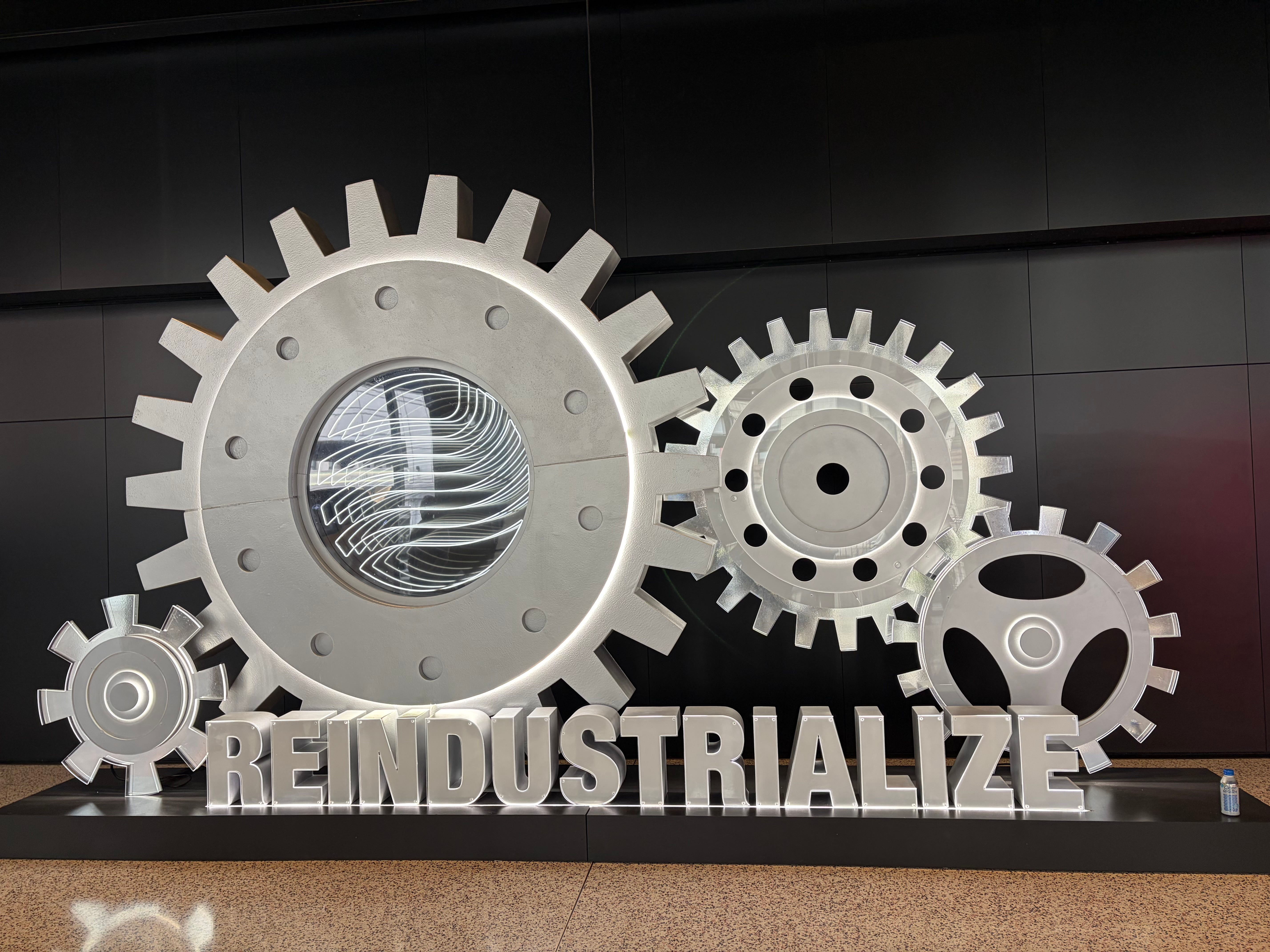
Make America Build Again: This is the aim of the yearly Reindustrialize Summit, held this week over two days in downtown Detroit.
No city has suffered more from globalization and deindustrialization than Detroit, formerly the world’s king of manufacturing.
But with downtown looking spiffy and ready to take in all visitors and a president in the White House who wants to make Motor City manufacture again, the conversation has changed.
At Reindustrialize, it was a discussion joined by everyone from small-startup entrepreneurs to people from large-scale companies like Palantir.
It’s not whether America — and Detroit — can reindustrialize and how. It’s about how to remove obstacles from the path.
Christopher Johnson is president of the American Energy Leadership Institute, whose mission is “energy dominance.”
“We want to mobilize the grassroots and grass tops, so everybody from your county commissioner all the way up to guys like myself that are on Fox News and on TV, going into the policymakers and telling them we want all of it,” Mr. Johnson told The Washington Star.
“We don’t want just oil and gas, we don’t want just coal or just nuclear,” he added. “We are going to need all of it. We want to reindustrialize.”
After the North American Free Trade Agreement took effect in 1994, deindustrialization was the mode in American industry and government. Jobs were shipped away from places like Detroit and Warren, Michigan, to places such as China and Mexico. Americans were told to celebrate this “creative destruction.”
But in recent years, mostly since COVID, there’s been a movement to bring home America’s industrial base. This involves everything from robotics to aviation to rainmaking.
Literally. The American Rainmaker Co., which had a booth at Reindustrialize, uses drones to carry out cloud seeding in dry areas.
CreateMe is a California-based apparel company that uses robots to put together clothes, such as T-shirts, with adhesives. Nick Chope, its chief engineer, pushed back on the trope that robots will cost people their jobs.
“We employ 30 people,” Mr. Chope said. “Those jobs would not exist if not for robotics. There’s not a factory in Detroit that doesn’t employ robotics. You have to, or you fall behind.”
The conference program was styled like a newspaper — another industry that’s fallen on hard times in Detroit.
“The New Arsenal of Democracy,” read the above-the-fold headline. It was a reference to Detroit’s role in building weapons America needed in World War II. The city’s central role in weapons production earned it the moniker “the arsenal of democracy.”
“The time for stagnation is over,” said the front page of the program. “The time to build is now.”
This year marks the third Reindustrialize summit. The 2026 theme: “from diagnosis to execution.”
The event attracted industry experts, lobbyists, and curious souls to the newly rebuilt Hudson’s Building on Woodward Avenue. Hudson’s closed in 1983, ending the era of the downtown department store in the city. The shopping mall was a creation of A. Alfred Taubman and originated in suburban Detroit.
After the 1967 riot, suburbanites came to prefer shopping closer to home than traveling downtown, and for many decades downtown Detroit was a shell of itself. As Ze’ev Chafets detailed in “Devil’s Night,” Detroit Free Press reporters in the 1980s used to play a game called King of the Corner.
If someone could go to a downtown corner, look in all four directions, and not see a soul, they were King of the Corner. That game could not be played nowadays. Not downtown, anyway. There’s too many people. Too many options. Too much foot traffic.


