Iran Plays a 9/11 Game With America in Switzerland
JD Vance's optimism is sorely misplaced.
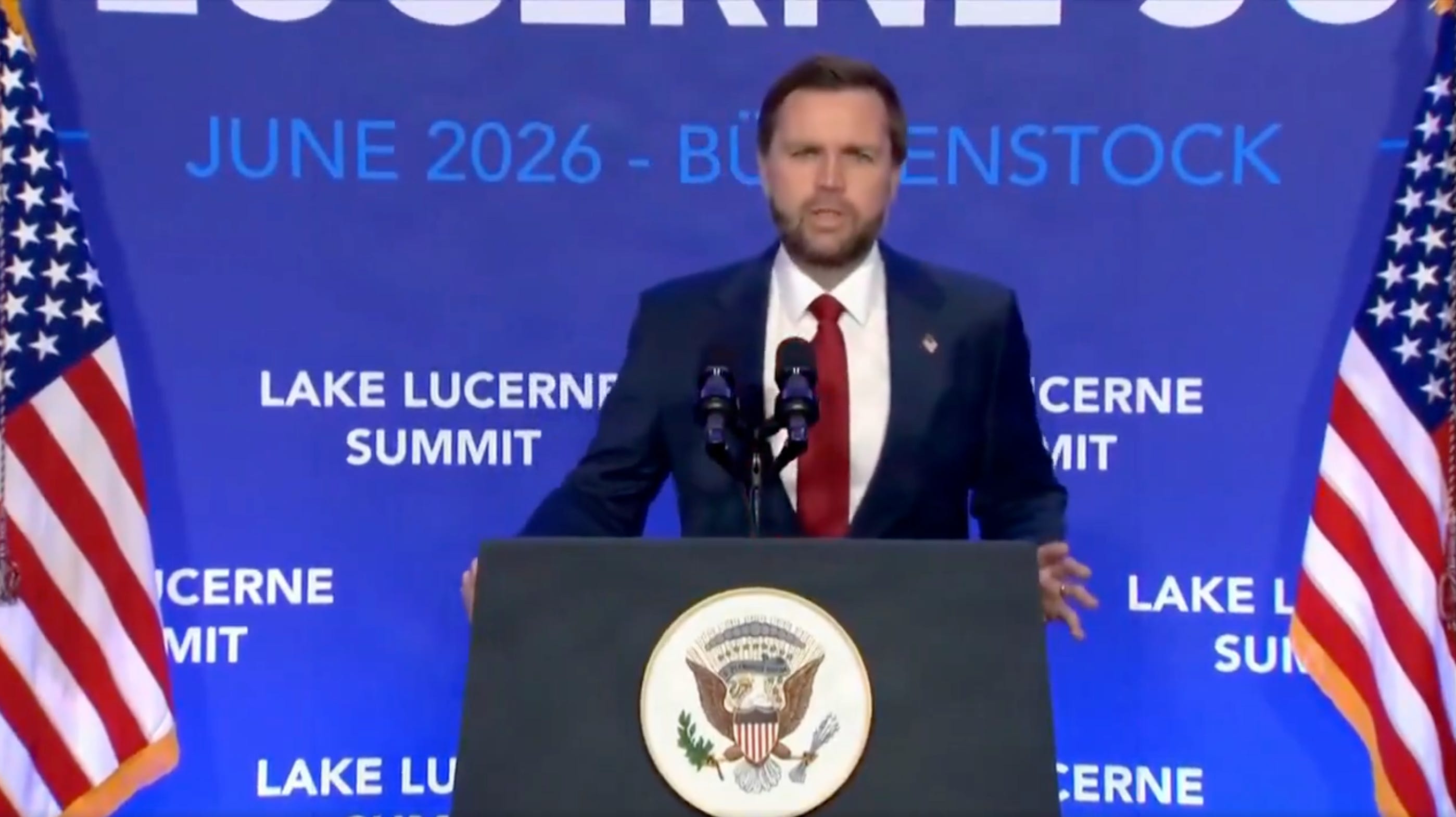
Optimism is a good way to keep winning the peace. But it is a lousy way to win a war. Realism is what is needed, not some starry-eyed, misguided belief that Iran wants peace more than the United States does.
It decidedly does not.
To that end, let’s not forget that the U.S.-Israel war against the Islamic Republic of Iran hasn’t been won yet. Nor has Tehran unconditionally surrendered.
Thus, when Vice President JD Vance tells us, “Yesterday was a very, very good day,” forgive us, but we want to know exactly for whom. Iran or the White House?
Mr. Vance is convinced it is the United States. He pointed to Tehran’s agreement to invite the International Atomic Energy Agency inspectors back to Iran.
The vice president hailed Iran’s offer as a “major milestone for the American people” and touted it as “the first step” in permanently ending the country’s nuclear-weapons program.
Forgive us — again! — but we’ve seen that IAEA movie before. Iran invites the inspectors, but the invitation is really just to play a shell game as Tehran hides or relocates elements of its uranium-enrichment program.
Need an example?
Start with Pickaxe Mountain. Iran still has not admitted it is being used as a new location to hide its nuclear-weapons program deep underground.
Pickaxe Mountain is only a mile away from Natanz, another major Iranian nuclear facility that America and Israel bombed during the 12-Day War and again after February 28.
So far, Iran has only conceded it is using Pickaxe Mountain to “house a production plant for assembling centrifuges.” The very centrifuges needed to highly enrich uranium to 90 percent weapons-grade level.
This is a high-stakes game. It is so high stakes that it really should be viewed as a nuclear 9/11-style play by Iran. Obbürgen, Switzerland, is an idyllic locale. But the game Iran is playing in the Swiss Alps is as deadly as it gets.
In the balance: Avoiding a nuclear 9/11. Republican Senator Tim Sheehy recognizes the peace talks are simply Iran trying to buy time under the guise of waving an olive branch.
Why?
Because Iran’s intent — as it has always been and will remain as long as the Khamenei regime stays in power — is to be an existential threat against the United States or, as it calls us, the Great Satan. Mr. Sheehy is right.
While appearing on “Fox & Friends” early Monday morning with Brian Kilmeade, the Montana senator warned that Iran’s aim is to inflict an “October 7 times a million” on America.
Yet as alarming as that is, the United States, by allowing Iran to sell oil after signing the memorandum of understanding, is helping Brigadier General Ahmad Vahidi, the head of the Islamic Revolutionary Guard Corps, put down payments on future renewed attacks against American interests.
That’s madness, not to mention needlessly self-defeating. The IRGC has not stopped killing Americans for 47 years, and it is not about to stop now because of a memo.
Decision point: As Mr. Vance returns to Washington Monday from Geneva, he would be well served to understand he did not extract any concessions from Iran during the first stage of the post-memorandum talks Pakistan and Qatar mediated.
Instead, he needs to recognize that Iran views these concessions not as genuine or lasting commitments but as disposable negotiating levers it can pull, renege on, or manipulate whenever it advances its interests. In this regard, Tehran’s playbook has been clear since the war’s beginning.
Iran, for example, has closed the Strait of Hormuz to pressure global oil markets to fend off additional U.S. attacks. Ditto Tehran’s intentional targeting of its Gulf state neighbors with ballistic missiles and drones.
Iran did it again by tying Hezbollah to any peace deal, which proved effective in dragging out negotiations to reach an initial agreement and the current 60-day negotiating window.
Now, in a rinse-and-repeat act, Tehran is doing it again with IAEA inspectors. Expect any and all of these levers — the strait, Gulf state attacks, Hezbollah, and IAEA access — to be used as needed to play, as Mr. Sheehy aptly put it, “rope-a-dope” with the United States.


