
Iran Bombs U.S. Military Forces in Kuwait as Regime's Internal Disorder on Full Display
Your guide to what's news in foreign affairs — and why it matters.
IRAN GOES BALLISTIC AGAIN IN KUWAIT
Iran, for the second time in three days, targeted the American military forces at Ali Al Salem Air Base in Kuwait. Monday’s first ballistic missile attack injured five U.S. soldiers and contractors. Two MQ-9A Reaper drones, each costing $50 million, were also damaged.
The strikes involved at least one ballistic missile and multiple drones.
Earlier, U.S. Central Command announced America conducted retaliatory strikes on Saturday and Sunday on radar and drone sites inside Iran, including Goruk, Qeshm Island, and Sirik. CENTCOM characterized the U.S. strikes as “measured and deliberate” and in response to Iran shooting down a U.S. MQ-1 drone that was operating in international waters.
In the balance: The escalation between the United States and Iran comes amidst rising tensions over peace talks between Washington and Tehran and an expanding Israeli ground operation pushing farther into southern Lebanon.
Iranian Foreign Minister Abbas Araghchi declared on X today. “The ceasefire between Iran and the U.S. is unequivocally a ceasefire on all fronts, including in Lebanon.”
The Islamic Revolutionary Guard Corps continues to demonstrate it is not serious about reaching a deal with the United States or at least not one on terms President Trump could accept.
IRAN PREPARES TO BURY KHAMENEI IN A GRAND STATE FUNERAL
Ayatollah Ali Khamenei, Iran’s supreme leader for 37 years, was killed February 28 in the opening strikes of the U.S.-Israel war against the Islamic Republic.
He remains unburied.
Shia burial practices customarily entail interment within 24 to 72 hours of death. Khamenei’s state funeral was originally scheduled for March 4 to 6. It was postponed indefinitely due to security concerns stemming from the war.
In its place, Iran staged nationwide rallies marking the traditional Shia memorial observance known as Chehelom — which literally means “40th day” in Farsi — to commemorate Khamenei’s death. Usually, Chehelom marks the end of Shia mourning. Instead, it became a placeholder for his funeral.
Tehran announced Friday it is finally preparing a “grand” funeral for Khamenei. Mohsen Mahmoudi, an Iranian regime spokesman, said, “Different organizations are working to provide the necessary conditions so that, once officially announced, a ‘grand’ ceremony can be held.”
In the balance: This prompts the question: Why now? One possible explanation is the regime, in reaction to reports it is fractured, is attempting to demonstrate national unity for domestic and international audiences.
Yet another is the regime is confident it has negotiated the Trump administration to a standstill in the Strait of Hormuz and is looking to take a victory lap with Khamenei’s funeral.
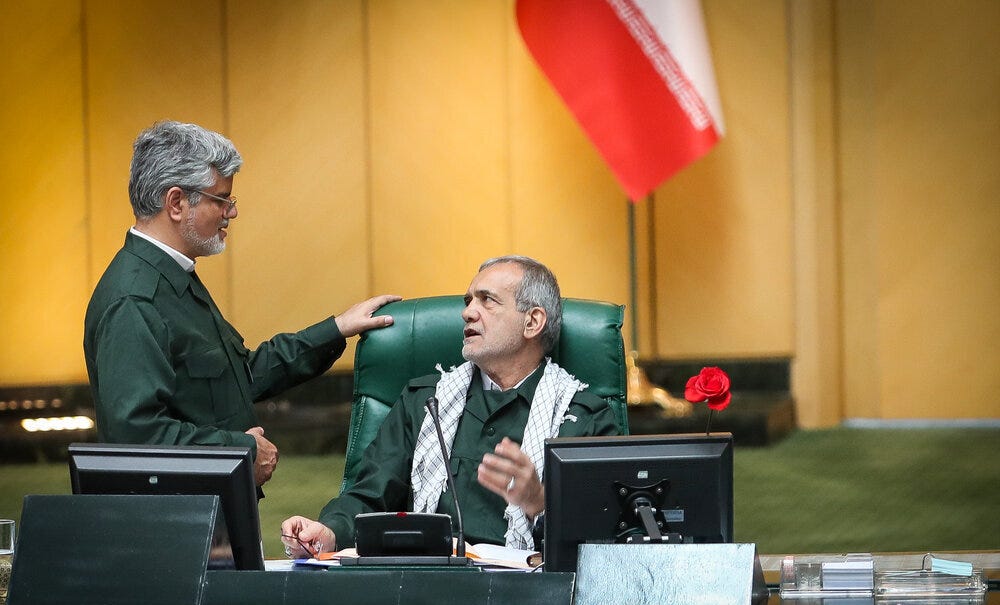
DID IRAN’S PRESIDENT MASOUD PEZESHKIAN ATTEMPT TO RESIGN?
Iran International reported Sunday that Masoud Pezeshkian, the Iranian president, tendered his official letter of resignation to Mojtaba Khamenei, the country’s new supreme leader.
Pezeshkian’s purported resignation came after he said reports from IRIB, Iran’s state broadcaster, “fail to accurately reflect the realities on the ground.” He also urged a serious review of the state-run media company. Soon after, IRNA, an IRGC-controlled Iranian news outlet, denied that Pezeshkian had resigned.
Subsequently, Pezeshkian’s office denied the report as well.
In the balance: This could be a sign of division in Iran, or it could be Tehran’s latest Kabuki theater production. The Iranians are very good at creating strategic ambiguity, especially when negotiating with Washington.
If so, the Iranian play might be to persuade Team Trump to make even deeper concessions to Tehran moderates or face negotiating with IRGC hardliners.
President Trump should not fall for it. There are no moderate decision-makers in Iran.
ICYMI, RUSSIA ATTACKED ROMANIA, A NATO MEMBER STATE IN EASTERN EUROPE
Romania’s Defense Ministry confirmed Sunday that an apartment building in Galați, located in the far eastern region of the country, was struck by a Russian Geran-2 drone.
The city, and its large river port, is located on the Danube and only 6 miles from where Moldova’s, Ukraine’s, and Romania’s borders come together.
Russian President Vladimir Putin dismissed responsibility, claiming that “nobody can know the origin of the drone.”
This is not the first time a Russian drone has struck Romanian territory. There have been at least four incidents, including twice in 2025 and now twice in 2026.
Oana Toiu, the Romanian foreign minister, stated on X that the Russian attack is a “serious and irresponsible escalation.”
Russia has repeatedly violated and harassed NATO territory since its full-scale war with Ukraine began February 24, 2022.
On September 19, 2025, three Russian MiG-31 fighter jets violated Estonian airspace. During the week of April 13, NATO was forced to scramble fighter jets to intercept Russian Tu-22M3 strategic bombers flying without transponders. In early May, a NATO jet shot down a Russian drone flying over Estonia.
In the balance: The Kremlin, since February 2022, has waged a hybrid campaign against NATO, including conducting espionage, sabotage, media-disinformation campaigns, and election interference.
Now Moscow is overtly testing NATO’s resolve to keep arming Ukraine, especially in light of the Pentagon’s decision to cut back U.S. commitments in Europe. Putin is also challenging Article 5, NATO’s collective-defense clause.


