How Ukraine Is Getting Closer to Liberating Crimea
It's what Vladimir Putin fears most.
Retired U.S. Army Lieutenant General and former commander of U.S. Army Europe Ben Hodges has called the Crimean Peninsula “decisive terrain” since the beginning of the war.
And it is.
This dominant piece of occupied terrain affords Russia the ability to exert its influence over the entirety of the Black Sea region, secures its southern flank, and lets it disrupt traffic into and out of the Ukrainian seaports of Odesa, Kherson, and Mykolaiv.
But equally as important, Russian President Vladimir Putin believes, “Crimea has always been an inseparable part of Russia.” It’s “a cornerstone of Putin’s reimagined Russia,” as one observer put it. Therefore, it is personal. Former Secretary of State Antony Blinken even went so far as to describe the strategic Black Sea peninsula as a “red line.”
Ukrainian President Volodymyr Zelensky does not see it that way. For him, and most of his countrymen, Crimea is Ukraine.
In support of that stance, Ukraine took two additional steps towards isolating Crimea from Russia this week with the goal of eventually taking back the land mass.
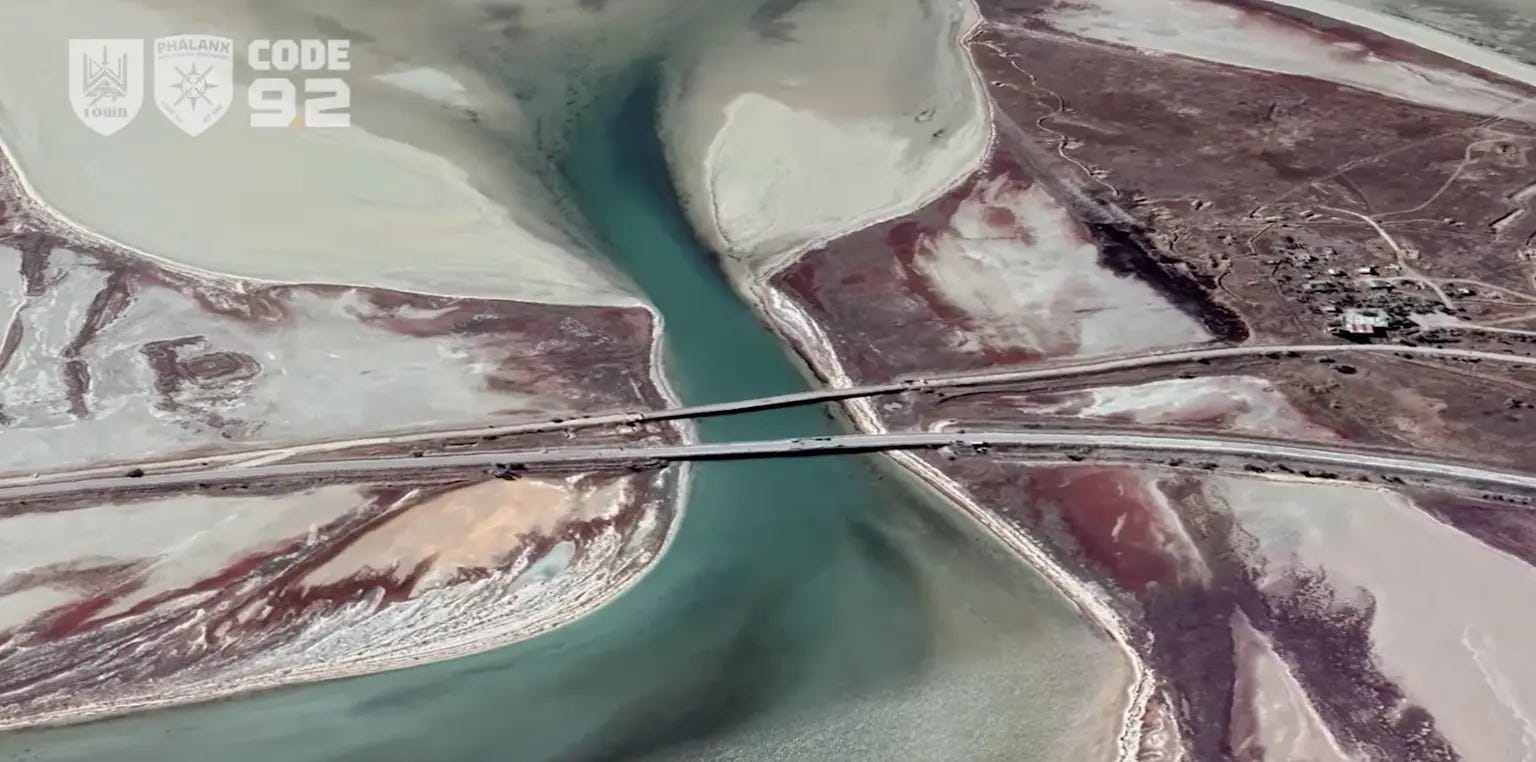
Vladimir Saldo, the Russian-installed governor of the Kherson Oblast in Ukraine, said Sunday the Chonhar bridge, which connects Crimea with Russian-controlled parts of southern Ukraine, was damaged in a Ukrainian drone strike. The Ukrainian military readily confirmed the claim by releasing a video of the joint strike conducted by the Code 9.2 drone unit and 1st Separate Assault Battalion with Fire Point drones and its new long-range Behemoth unmanned aerial vehicle.
The Kyiv Post reported Tuesday that Russia’s 337th Regiment was forced to withdraw from the Kinburn Spit — a dominant piece of terrain that controls access to Ukrainian seaports – in southern Ukraine’s Mykolaiv region after Ukrainian strikes disrupted supply routes to the area.
In the balance: As Mr. Zelensky has stated, “It began with Crimea, it will end with Crimea.” Ukraine is setting conditions to isolate the Crimean Peninsula, make it untenable for Russian forces to occupy, and then eventually liberate it.
It’s a modern-day version of siege warfare — Ukraine’s Yorktown if you will — but on a much grander scale. Interdiction of supply lines and deep strikes are the method; Ukrainian-manufactured weapons, courtesy of defense firm Fire Point, are the tools.
Supporting the effort are the deep strikes targeting Russian revenue sources to fund the war: oil.
Mid-range drone strikes are interdicting Russian logistics along the “land bridge” — the swath of Ukrainian territory occupied by Russian forces stretching from the Donbas region along the Sea of Azov to Crimea — bleeding Crimea dry. The Chonhar bridge is the last stop in occupied Ukraine on the land bridge to Crimea.
The loss of Crimea would be a much greater humiliation to Putin than the two drone strikes near his hometown last week during this year’s Saint Petersburg International Economic Forum.
Decision point: The fait accompli comes when Ukraine destroys the Kerch Strait Bridge to complete the isolation. According to Mr. Hodges, “Once you get the Kerch Bridge down again, this completely changes the game for Crimea, which is what matters the most.” That happening is what Mr. Putin fears most.


