

Don't Believe Putin Will Negotiate With Zelensky
The Russian president has no plans to end his war on Ukraine.
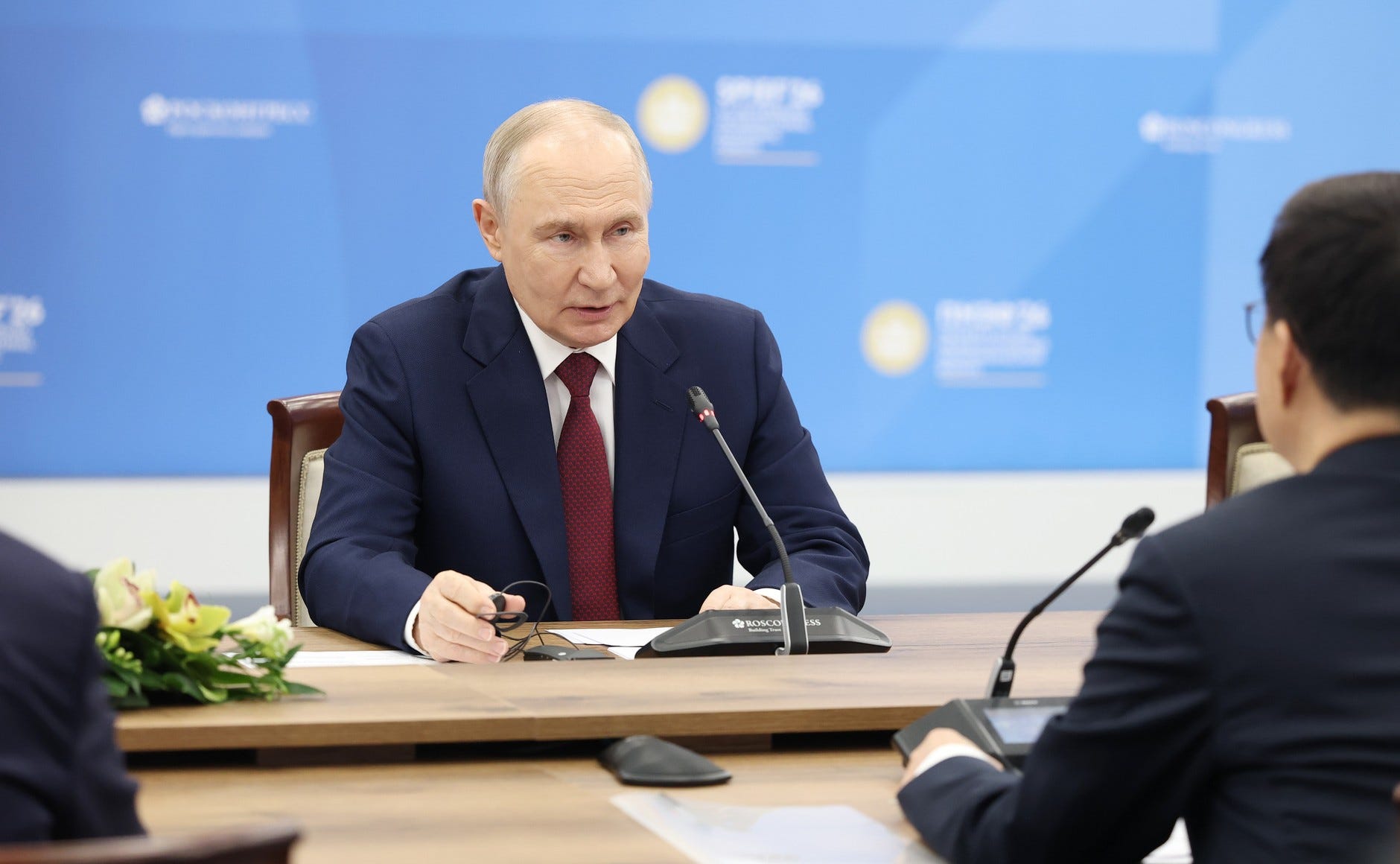
A silver lining of sorts presented itself briefly after Ukraine’s drone attack on the St. Petersburg oil terminal and Kronstadt naval base Wednesday. Russian President Vladimir Putin said he was open to resuming peace talks with Ukraine and reaching a peaceful agreement.
When asked what he would say to Ukrainian President Volodymyr Zelensky if they ever signed a peace deal, he responded, “Thank God it’s all over.”
Seizing the moment, Mr. Zelensky sent a cleverly written open letter to Mr. Putin June 4 proposing an immediate ceasefire along the current frontline and a face-to-face bilateral meeting in a third country to end the war.
The letter was very direct. It listed all of Mr. Putin’s failures in Ukraine and concluded by reminding him of the cost of prolonging a war that he cannot win: “When Russia grows tired, change comes.”
On the surface, this seemed promising; but when you listen to Mr. Putin’s entire statement, peace from his point of view can only come when Mr. Zelensky withdraws his military from the Donbas region.
That is not going to happen.
This is just a repackaged set of maximalist Russian demands neatly tucked behind the smirk of an indicted war criminal. Nothing has changed.
Mr. Putin later invoked an alleged agreement he made with President Trump during their Alaska summit last year, one made without Mr. Zelensky’s knowledge or consent.
So far, if it exists, Mr. Trump, much to Mr. Putin’s frustration, has not been able to deliver.
As Mr. Zelensky stated in his open letter, “Ukrainian issues are not decided in Anchorage.”
Mr. Putin responded to the open letter June 5 while speaking at the St. Petersburg International Economic Forum, Russia’s version of Davos. He said, “I see no point in meeting. It only makes sense for the Ukrainian side to stop the advance of our armed forces. Let the experts work, develop some solutions, and then we can meet.”
Many observers, including us, did not believe him. Plus, as an opinion column in the Russian Federation newspaper Komsomolskaya Pravda observed, “peace talks are for losers.”
The Kremlin has no intention of showing weakness, despite its inability to secure its own skies and sustaining monthly casualty rates over 35,000 soldiers.
Other indicators?
Russian Foreign Minister Sergey Lavrov referred to Mr. Zelensky’s open letter as “nonsense,” saying, “Moscow will dictate the terms.” Kremlin spokesman Dmitry Peskov added, “If Zelensky wants to talk, he can come to Moscow and do so.”
Only Igor “Strelkov” Girkin, a hardline Russian former intelligence officer, would acknowledge Russia’s current predicament:
The enemy [Ukraine] is currently on the rise, and our air defense forces are unable to repel these attacks everywhere. And the number of enemy tactical drones once again exceeds the number we are prepared and capable of deploying by an order of magnitude. To negotiate directly with Zelensky, we must first achieve victories. Then we will be able to speak with him, at least from a position of strength.
Russian ground forces are on the verge of being cut off — isolated — on the Crimean peninsula. Ukrainian-established “kill zones” are decimating Russian ground forces. Ninety percent of Russian soldiers are now being killed before they even reach the front lines, and 96 percent of those casualties come from remotely operated drones.
After hearing Mr. Putin’s response Friday, Mr. Zelensky commented, “Russia is choosing war again.”
In the balance: During a press conference Thursday, Mr. Putin acknowledged that Russia needs to strengthen its air-defense system. Then he signaled what was likely to come next: “But Ukraine doesn’t have such a system. They just have some individual components, but there is no system.”
The Russian recourse to every setback, to every defeat on the battlefield, is to launch hundreds of ballistic missiles, drones, and glide bombs at Ukrainian cities. More and more Oreshnik missiles will likely be used. Their targets? Ukrainian civilians in their homes, schools, marketplaces, churches, hospitals, and bomb shelters.
Now, more than ever, the West needs to equip Ukraine with an integrated air-defense system and/or establish a no-fly zone. Five years without both is enough.
 | A guest post by
|
 | A guest post by
|